Author Archives: Cassandra Chin

Adventures abound

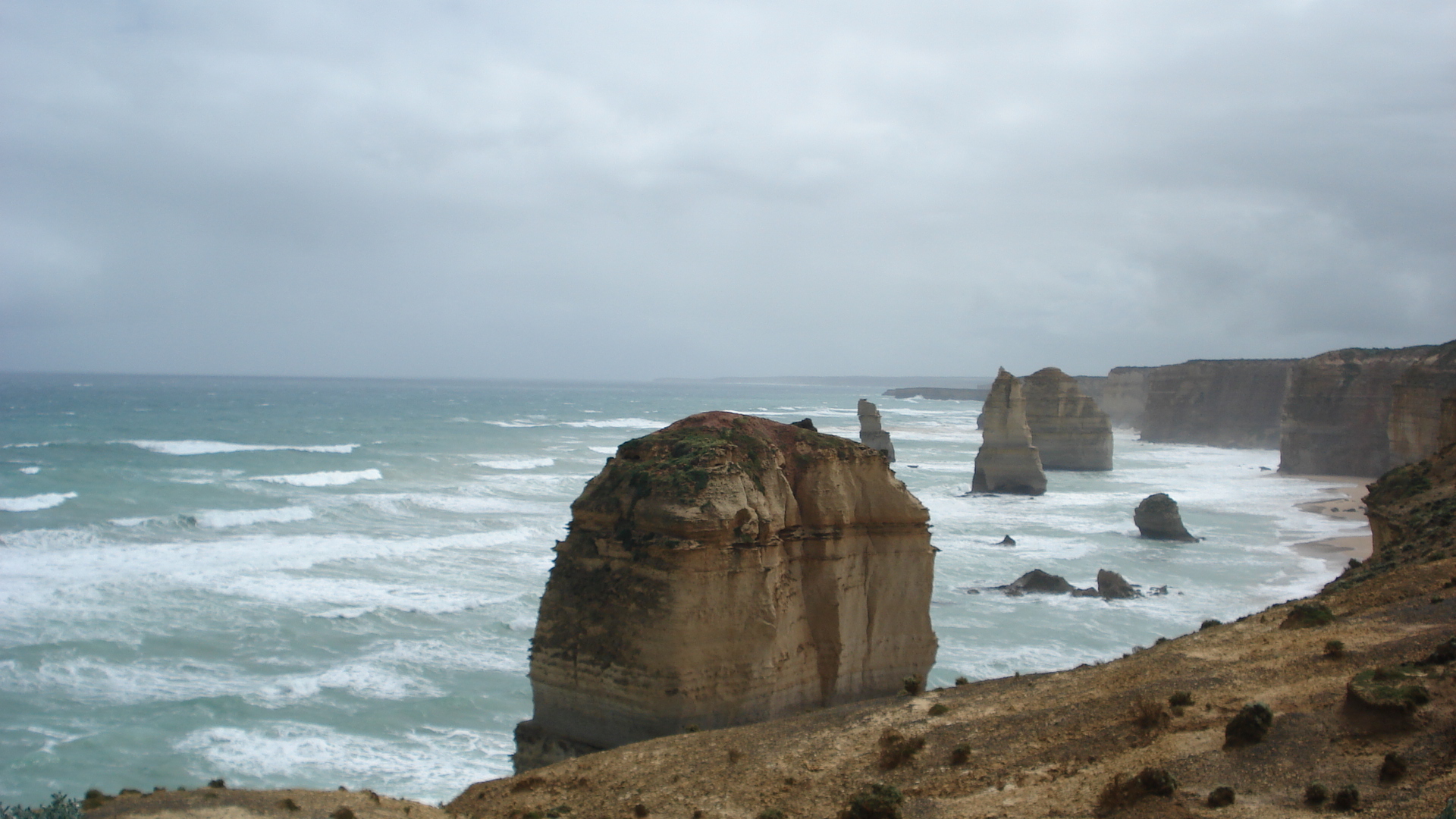
DSC06223

The 12 Apostles, one of the many stops along the Great Ocean Road in Australia.

All adventures begin as soon as you step out the door, not when you arrive at your preferred destination. That being said, whenever one intends to travel to a location taking multiple airlines and stopovers, it’s bound to create a few stories.

Long story short: the first flight was delayed which resulted into a mad rush to catch the second flight, in which one of the passengers had a medical emergency that resulted with all the other passengers stuck on board when we landed until the paramedics attended to said passenger, followed by a second attempt at becoming the Flash to catch our third flight that was 14 hours in duration. The third flight had an adorable baby on board, and for an overnight flight of that length, the idea of having a baby on board is cringe-worthy in itself. Needles to say, I was quite surprised when said infant remained quiet for most of the flight, only letting out a mild protest once when being moved, but was otherwise a happy little fellow. If only all children who travel can be that well-behaved! I am also happy to say all the flight attendants were a pleasure to associate with and happy to assist with any questions, which is not always the case.

Customs is as it always is: long and tedious, coupled with interesting folk and stifled laughter, while baggage was less of a nightmare than usual.  However, it’s walking through the gates and seeing family again after a prolonged period that makes the length of any trip worthwhile. Ok, that and the warm weather after an unusually cold winter on the other side of the hemisphere. Shorts and tees, here I come!

As with any trip down under, and that’s where I am if you haven’t gathered from picture above, there will be lots of outdoor activities (more of the hiking sort than beach lounging), eating, committing to the mandatory tourist ploys before heading off the beaten tracks, along with training in between with some senseis that I’ve had the pleasure of meeting in a previous trip, and catching up with family.

I currently train under an Okinawan-based martial arts known as Koryu Uchinadi, and will have the immense pleasure of learning from several senseis in Australia, including Hanshi Patrick McCarthy himself. If nothing else comes of this trip, I am looking forward to soaking up whatever knowledge I can from them, corrections and all.

Enough said for now, except allons-y!

Tagged , , , , , , ,

Greek mythology meet Percy Jackson

Harry Potter and the Order of the Phoenix had just hit the screens when my friend introduced me to the Percy Jackson series by Rick Riordan.

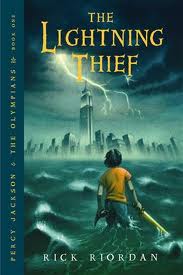
LighteningThief

Percy Jackson and the Lightening Thief is the first novel in Rick Riordan’s Percy Jackson series.

By this time, there was already four books out in the series with a growing audience – myself included. What I love about this series is how Riordan takes Greek mythology and introduces it to readers in a fun, yet educational way. The Percy Jackson series has since concluded, yet the tales of half-bloods continue in The Heroes of Olympus sequel series.

I have always been intrigued by myths (Greek, Native, South African, etc) and this series takes a look at Greek mythology with a different twist to its well-known heroic tales. Riordan not only manages to engage readers with interesting characters, he is able to weave social, political and environmental concerns subtly into conversations between characters. I wouldn’t consider it so much as propaganda, since it offers both views, but the concepts are brought down to an adolescent concept and the ideas definitely begin to tickle the mind of the young. 

In brief, The Lightening Thief (the first book in the series) introduces readers to Percy Jackson, a 12-year-old dyslexic, ADHD teen struggling to fit in at school. Or, as Jackson puts it:

“My name is Percy Jackson. I’m twelve years old. Until a few months ago, I was a boarding student at Yancy Academy, a private school for troubled kids in upstate New York. Am I a troubled kid? Yeah. You could say that.”

Essentially, after returning home from boarding school, he and his mother Sally Jackson go on an impromptu road trip to their favourite beach in Montauk. A series of tragedies follows, as per any novel in which a protagonist begins his journey of self-discovery, including being chased by a minotaur and finding out his best friend is a satyr. He also finds out he is a demigod and son of Poseidon, the God of the Sea. The first book in particular follows Percy and his friends quest to clear his name after being blame of stealing Zeus’ prized lightening bolt.

In Riordan’s take of Greek mythology, demigods/half-bloods are born with various degrees of ADHD and dyslexia. Reading English is generally pretty difficult and causes headaches, while Ancient is a breeze, for example. The ADHD in demigods is caused due to natural battle instincts and quick reaction times. Riordan’s world is set in the modern era and with the change in times, Mount Olympus is  now located in New York. Camp Half-Blood, a boarding/training school of sorts, has become a sanctuary for demigods learning to control their powers. Humans, on the other hand, cannot see behind the “mist,” and only see what they want to believe, rather than what is truly in front of them. As Percy Jackson continues his many adventures, he stumbles upon magical items such as the Golden Fleece, the living dead, and various forms of opposition from gods set in their ways.

Each book that follows (re)introduces new gods and those less familiar, old characters, and always re-imagines the world with a mythological take. Following The Lightening Thief, are: The Sea of Monsters, The Titan’s Curse, The Battle of the Labyrinth, and The Last Olympian – each as humorous as the last:

“Wow,” Thalia muttered. “Apollo is hot.”
“He’s the sun god,” I said.
“That’s not what I meant.”
-Percy Jackson and Thalia, daughter of Zeus upon meeting Apollo in The Titan’s Curse

As with many novels with multiple books supplementary works include: The Demigod Files, The Ultimate Guide, graphic novel, Demigods and Monsters, and The Demigod Diaries.

*Spoilers Alert*

Nevertheless, The Heroes of Olympus sequel series looks at combining Roman and Greek mythology of the gods and begins with Percy mysteriously missing and a Roman demigod taking his place. It becomes a conflict for gods and their split personalities: Zeus vs. Jupiter, Poseidon vs Neptune, etc etc. It’s dissociative identity disorder at its finest.

Again, for all that Riordan’s Percy Jackson series are an easy and fun read, with a zap of romance, what I love best about them saga is the underlying social commentary about the world. From the environment to political hub-dub, Riordan touches base on important issues. 

In The House of Hades, the fourth novel in the sequel series, Riordan chose to make brooding Nico di Angelo come to terms with what many teenagers face: emotional indecision of who they are and what is “right and wrong.” What many readers may have thought of as Nico in love with Annabeth, was really an underlying emotional attraction to Percy, someone who save his life. As a child born in the 1940s and kept alive through sorcery and a magical casino, being gay was not accepted in society. Though years have passed since then, Nico is still faced with what was then and what is now. It will be interesting to see how it the characters will continue to develop and what the future has in store for these young demigods.

Book Five in the Heroes of Olympus series, The Blood of Olympus, is set to hit the bookshelves Fall 2014.

Tagged , , ,

‘In Death’ captures futuristic crime in a suspense-filled series

“You know, lieutenant, you wear your weapon the way other women wear pearls.” “It’s not a fashion accessory.” -Roarke to Lieut. Eve Dallas

I’ve come to the conclusion that part of my overzealousness in purchasing new books stems from my impatience of waiting for holds placed in a library – especially when you find a new series that’s captured your attention. (Let’s disregard the whole e-reader thing, I’ve heard that spiel far too many times). My friend recently reminded me of J. D. Robb’s In Death series – one I’ve heard about over the years but haven’t gotten around to reading.

J. D. Robb, a pseudonym for Nora Roberts, takes a futuristic look at crime in New York City in the year 2058. The suspense thriller has elements of a sci-fi thriller that touch upon laser guns, flying vehicles, and off-world stations. The gun, for instance, is considered an antique and collectible, an outdated weapon that is the focus of the murder investigation in the first book.

Her first novel Naked in Death introduces readers to Lieut. Eve Dallas, a tough, by-the-books 10-year veteran of the New York Police Department and Security Department. Essentially, she kicks ass. When she is first introduced as a character, she is described as a women of intellect and wit. Her self-cropped hair, whip-thin body sustained by caffeine, and physical attributes come later.

There’s nothing better than presenting a strong female character with a no-nonsense  persona and one committed to her beliefs. Troubled past aside, in which readers will discover more as the series progresses and helps with her development, Dallas has definitely entered my list of favourite female characters.

The characters Roberts (as Robb) has created for the In Death series are both well-developed and come from all walks of life: Summerset is his own brand of awesome. As Roarke’s current butler and former partner/mentor in crime, Summerset’s relationship with Dallas is hostile with a tinge of grudging respect on both ends. Dallas’ BFF Mavis Freestone is wild, crazy and free-spirited – she’s the comic relief, Dallas’ rock, and first real friend. Another main star is billionaire hunk Roarke and is considered one of the primary suspects in the string of murders due to his connections and shady past. Roarke and Dallas’ tumultuous relationship goes from passionate to tender, hot and cold instantaneously but grows into something deeper as the series continues.

For all that I dislike thrillers (my over imaginative brain tends to keep me up at night with thoughts of monsters and the boogie man) and am not the fondest girl-guy-meet-fall-in-love story lines (though I’m admittedly a sucker for Jane Austen), the In Death series is able to create unique murder mysteries involving high-tech gadgets – it’s regular crime revamped.  I find the series is equally intriguing not just for its varied crimes, but for Roberts ability to capture human nature not only at its finest, but its worst. It reveals, and foreshadows reality, that no matter how sophisticated technology becomes, humans will remain human. The plight of human desire and emotion, love and lust have not, nor will not changed throughout the years, no matter how many androids and robots enter the fray.

With over 40 novels and short stories in the series, it’s said Roberts will conclude with Dallas’ eventual pregnancy somewhere down the line. I’m excited to see what mysteries and adventures Dallas, Roarke and the rest of the crew will come across in this series. As such, I’ve already read the next two books and am eager to start the fourth, Rapture in Deathonce the library contacts me.

Tagged , , , ,

Swept Away: Meditations on the Uncommon Genius of Stephen King

“You cannot hope to sweep someone else away by the force of your writing until it has been done to you.”
― Stephen King, On Writing
StephenKing3

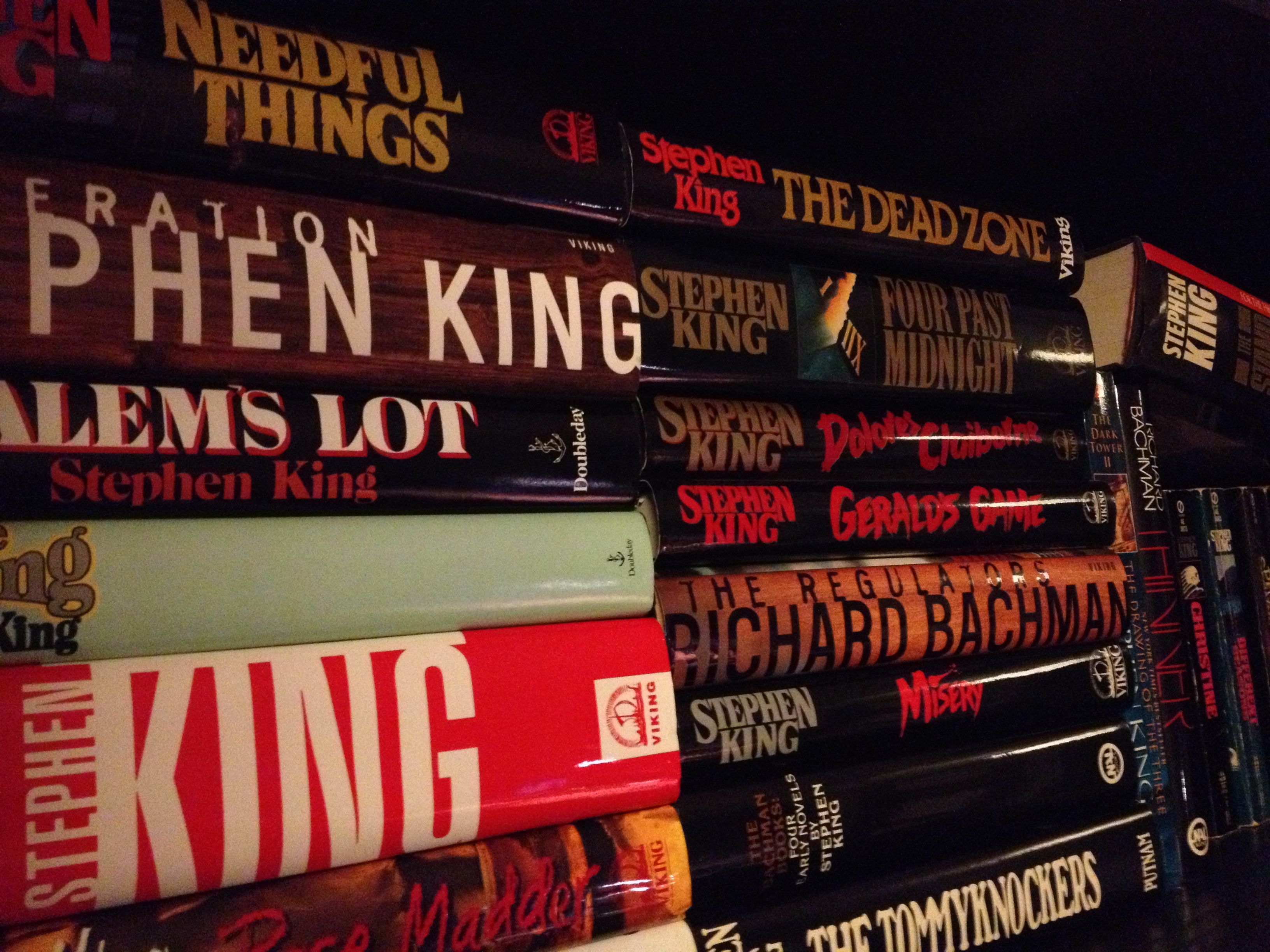
My growing collection of Stephen King novels.

From The Shawshank Redemption to The Green Mile and from Pet Sematary to It, author Stephen King is best known for leaving readers variously horrified, disturbed, or disgusted – yet equally captivated. King’s novels, short stories, audiobooks, essays, movies, comics (deep breath) poems, screenplays, and television shows, are among the undisputed classics of contemporary horror, suspense, science fiction, and fantasy.

Consider:

  • His works have sold over 350 million copies worldwide.
  • He has published another 200 short stories (to date), and under the pen name of Richard Bachman he has written seven fiction and five non-fiction books.
  • He has been awarded the Bran Stoker Award, the World Fantasy Award, and the British Fantasy Society Award – to name only a few. His novella, The Way Station, was also a Nebula Award novelette nominee.
  • And his accolades keep rolling in.

My first foray into King’s literary world was in high school, with his science fiction series The Dark Tower and its first book,The Gunslinger. I had heard of Stephen King before, of course, and had seen his many books lining the library shelves, but I hadn’t read any of his novels before picking up this book at a sale.

For those who haven’t read the series, let alone this novel: Go.

Now.

It’s brilliant. King himself describes this series as his magnum opus.

King’s masterful blend of fantastical horror and old-school western, touched with advanced technology – travelling between worlds, anyone? – results in an intriguing world and kickass characters. Oh, and there’s magic, too! The first novel introduces us to Roland Deschain of Gilead, the last living member of a knightly order known as Gunslingers. He is also the last in line of “Arthur Eld,” which is this world’s equivalent to the mystical tales of King Arthur. Roland’s quest is to find a fabled building known as the Dark Tower that is said to be the nexus of all the universes. Of course, along the way he stumbles across: a fanatic preacher he comes to call the Man in Black; some epic battles; and many, many questions.

The Gunslinger is a wonderful introduction to a crazy world; the book adeptly sets everything up for the forthcoming novels, of which there are eight in total. Admittedly, the first novel is sparse on details of Roland’s motives, goals and, well, personal life, but it does set up the remaining installments nicely.

A short story, “Little Sisters of Eluria,” was also written as a prequel, while the eighth book (or book 4.5, according to King), The Wind Through the Keyhole, was written in 2012 – eight years after the series officially concluded. A series of prequel comics were also published after the Dark Tower series was completed in 2004.

It just keeps going.

Soon after I finished The Gunslinger, my aunt surprised me by delivering a box of books – not just any books, but practically the entire collection of Stephen King novels available.

I was in heaven.

And then I realized that there were movies.

The more critically-praised King adaptations include The Shawshank Redemption and The Green Mile. Where Shawshank tells the story of a banker in prison for the death of his wife and a money laundering operation, The Green Mile looks at a death row supervisor and his encounters with supernatural gifts (healing, empathy). But of course many of King’s other literary works have been adapted into films or television shows: more than fifty, at last count.

The first such adaptation, Carrie (1976), revolves a high school girl who discovers she has telekinetic powers. A shy girl who is bullied and abused both at home and at school, she eventually exacts a shocking revenge on those who teased her. The image of Sissy Spacek in a delicate white dress with pig’s blood streaming down her face and off her arms is not easily forgotten; and a remake featuring Chloë Grace Moretz in the title role will hit theaters in October, 2013. Other notable King film adaptations include The Shining (1980), Children of the Corn (1984), Misery (1990) and Apt Pupil (1998).

On television, mini-series made of King’s works have long been acclaimed (It, Salem’s Lot, The Tommyknockers, The Stand). Most recently, after a tense few months of uncertainly, Syfy has announced thatHaven will get a fourth season this fall. Based on King’s “The Colorado Kid” and much lauded for its creative and quirky sci-fi whims and humor, Haven follows FBI agent Audrey Parker (Emily Rose, Jericho) and her journey to Haven, Maine to complete what appears to be a routine case but instead places her in the center of an enclave of people who possess a range of supernatural abilities. At this point, her past, which she can’t seem to recall, starts to emerge and the townspeople’s dormant abilities begin to express themselves.

The latest adaptation of King’s work is Under the Dome, based on his 2009 novel. Cloverfield’s Mike Vogel and Twilight’s Rachelle Lefevre lead an impressive cast that includes Breaking Bad’s Dean Norris andSabrina the Teenage Witch’s Beth Broderick. This series has debuted to mixed reviews; the general consensus has been that though its premiere was riveting, the following episodes proved lackluster. Where King is able to provide a subtle dimension to his characters in his novel, many viewers feel (and I concur) that the acting falls flat—which is a shame, since the pilot showed so much promise.

The novel of Under the Dome is a sociology experiment depicting how residents of Chester’s Mill, a small American town, cope with the sudden appearance of a transparent dome around their town. Yet despite the initial similarities, showrunner Brian K Vaughan noted the show aims to veer off course with a different ending than the novel. Despite the changes to the story – which were made with King’s approval – the author wrote in a letter to his fans: “If you loved the book when you first read it, it’s still there for your perusal. But that doesn’t mean the TV series is bad, because it’s not. In fact, it’s very good.” Good or bad, the first season of Under the Dome is slotted for 13 episodes, with each episode costing around $3.5 million. The fate of the series beyond the first season will depend on whether or not the pace picks up, but it’s still up in the air.

I’ve found that King’s novels range from featuring thought-provoking societal issues to disturbingly creepy situations that leave goosebumps trailing up my arm. There are some that I can’t put down, while others I can’t bring myself to finish. And there are some that I just cannot read at night. Between my overly active imagination and his vividly eerie worlds, sleep becomes the last thing on my mind.

Which is why I’m still working my way through the 823 brilliant but terrifying pages of The Stand.

Originally posted inGeek Speak Magazine.
Tagged , ,

Museums create interactive tech for disabled youth

In addition to creating audio-tactile maps to the Descriptive Video Exchange, Dr. Joshua Miele has another project — to improve the museum experience for disabled youth.

Miele is working closely with the National Federation of the Blind (NFB) to create a program where people, specifically blind youth, are able to interact with pieces within a museum.“A lot of museums are things that you largely look at and you don’t have an opportunity to interact with them,” explained executive director Mark Roccobono of the NFB. “There are a lot of great technologies out there that can provide descriptions about the items you’re looking at, and it would be great for blind people who visit museums.”

At the moment, art museums have a different set of problems than science museums, but the issue of the lack of accessibility to the works still remains.

Miele and the NFB are hoping to enhance access to several science museums for blind youth and their families with the help of the National Science Foundation.

In its first month of a three-year project, the Museum of Science in Boston and the Port Discovery Children’s Museum in Baltimore are currently involved. Roccobono hopes more museums will come on board later.

“We’re trying to inspire and engage blind youth in science, but also create a relationship between blind people on the local level and the science museum by working specifically on making some exhibits accessible,” said Roccobono, noting it’s a chicken-and-egg problem. “A museum says, ‘We never see any blind people in here so it’s hard to work on access for blind people,’ while blind people say, ‘We never go this museum because they never have anything that is accessible.’ If they do something accessible, it’s done cheaply so it’s not meaningful.”

The project is also looking to build a relationship between the museum and its visitors. Ideally the visually impaired can evaluate and provide feedback on what’s happening and the museum can work to integrate tools and techniques already available.

“It’s important that mainstream technologies are also accessible to blind people and that we have to recognize technology is not what makes people successful, but rather technology provides access to information we haven’t had before,” said Roccobono as the project continues to surge forward.
Overall, Miele and Roccobono agree the vast majority of work that needs to be done is making and providing people with better access in a manner that’s more mainstream and not just focused on the technology.

“I’m here developing these innovative tools and talking about how we can use these to make information more accessible, but I’m kind of out ahead of where most things need to be,” said Miele. “There’s a lot of basic work that needs to be done and most of it isn’t incredibly hard to do. It comes down to awareness and people understanding the problems.”

Future goals for Miele include accessible maps and interactive areas not just for public transit or museums, but also places like the airport that see a lot of traffic and is in need of good information.

Also in Assistive Technology

The series explores how advancements in assistive technology are helping the visually impaired and the disabled.

Originally posted in TechPageOne.

Tagged , , ,

How B.A.R.T. helps the blind get around

What started nine years ago with the creation of the Tactile Map Automated Production (TMAP) system for California’s Bay Area Rapid Transit (BART) system has developed into an audio-tactile graphic map to increase accessibility for the visually impaired.

Dr. Joshua Miele and his team at the Smith-Kettlewell Video Description Development Center are once again working alongside San Francisco’s LightHouse organization to make travelling easier with easy access to information.

“BART maps has been one of the ways I’ve been working on making information more accessible,” said Miele. “I developed a tool in 2004 called TMAPs and it was and is the only way a person can get the tactile feel of anyplace they want.”

Most people can go to Google Streetview or Google Maps and retrieve a lot of information, but those with visual impairments cannot get that same spatial context and information hence the creation of TMAPs. However, much of the Braille maps now are too cramped with information and certain areas are not labeled due to lack of space.

Miele and LightHouse are now working to launch the audio-tactile graphic maps in 43 of the 44 station stops. The project is a few months from being released.

These new maps allow people to explore the area through Braille, as well as audio stimulation. The maps incorporate Braille into its design, but it is not dense with information.

To get a more in-depth experience, you can employ a smart pen to touch the graphics and a computer will inform you about the part of the map you are touching. The use of smart pens is particularly adaptable for uses outside the public transportation system.

“There has been a lot of positive responses and the interest continues to grow,” said Frank Welte, information resource specialist and strip map coordinator of LightHouse. “A lot of people, not just the blind, are excited for the audio-tactile maps to help with their orientation of where they are and have to be.”

The importance of this technology is that once these maps are implemented, they’ll not only be useful to transit, but for other maps as well, added Wente.

“You can almost incorporate a guide book into the map, which is a future possibility,” he said.
The technology already exists in various forms but needs to be applied everywhere, said Mark Roccobono, executive director with the National Federation of the Blind, which is a membership-based organization of blind people in the United States.

“If we can get engineers and others to design technology with accessibility in mind from the beginning, we can then use technology that everybody else can use. It would be the same information, at the same time, at a different price, though we would access it through Braille or audio,” said Roccobono. “The importance of public transportation and having the technology make it accessible is helpful.”

He pointed to the audio and visual cues that most buses now have that announce which stop is coming up. In this case, audio cues are also helpful for visitors to the city or if English isn’t your first language.

There are other companies and organizations working to make information more accessible to blind people around the world, but Miele added that those projects aren’t currently at the scale of his team’s projects.

However, Roccobono noted the biggest problem facing blind people isn’t blindness itself, it is more the public attitudes toward blindness and technology doesn’t change that.

“One thing it (technology) does change is access to information,” he added.

Also in Assistive Technology

The series explores how advancements in assistive technology are helping the visually impaired and the disabled.

Originally posted in TechPageOne.

Tagged , , , ,

DVX: More content accessible to the visually impaired

Created by Dr. Joshua Miele and his colleagues at the Smith-Kettlewell Video Description Development Center in San Francisco, California, the Descriptive Video Exchange (DVX) provides an audio descriptor narrating the scene or moment in the program.

DVX is still in early development where large load balancing and optimization of geographic use doesn’t require multicloud use at this time. However, Miele noted it’s called cloud-based because it helps people understand that the project is all on the Internet and not a program that runs on one’s PC or smartphone.
What’s important to note is that the server itself does not store the original videos; rather, it holds only the descriptions, identification and timing information, and works in time with a video player that plays whatever video you want to watch.

At present, those who are visually impaired are able to access videos, such as movies or television shows, and listen to the dialog and music it contains. However, what remains missing is a certain visual context that is currently unavailable for most videos.

“We are looking into the future, where the vast majority of video will not be consumed via broadcast media. It will be consumed over the Internet,” he explained. “We are looking at a day coming very soon when electronic textbooks will contain embedded video.”

Though video description was invented in the 1970s as a way to give blind people access to information on what’s occurring digitally on the screen, it was mostly for entertainment.

However, video description isn’t only about the luxury of entertainment now, said Miele.
“Now there’s a great deal of education and job training and healthcare-related information distributed to video,” he explained. “If you don’t have access to the information on the screen, blind people won’t be educated or have the same access to job training as sight people do.”

Miele points to websites, including YouTube, where people can upload their own videos that have changed the landscape of accessibility for those with visual disabilities.

In order to create a described video, users would previously have to get permission from the copyright holder, he added.

“We’re interested in the idea of crowd-sourcing video description so that anybody anywhere can describe any online video for anybody anywhere else,” said Miele, adding they are currently looking into the legal and fair trade aspects of the project. “We aren’t redistributing or copying the video, we’re not doing anything to the video other than playing with it simultaneously with the described content.”

DVX is currently available upon request.

Along with creating DVX, Miele is working with his partners to create youdescribe.org, which will provide audio descriptors for popular YouTube videos.

The site itself has a little over 100 videos currently available to watch with audio descriptors, but it allows the public to record their own audio descriptors before sharing the result to the public.

Here′s a sample of a descriptive video.

Also in Assistive Technology

The series explores how advancements in assistive technology are helping the visually impaired and the disabled.

Originally posted in TechPageOne.

Tagged , , ,

SMBs use multi-clouds to ramp up customer service

Transferring and storing data has never been easier with the assistance of cloud services, something that allows companies to streamline their work and increase efficiency toward customer service.

Businesses are able to use each cloud service provider to improve their end game and customer service, explained Michael Zafiris, a software specialist and Google Apps Certified Deployment Specialist at InterlockIT.

Where larger cloud providers target business, Dropbox and others such as SugarSync and ADrive have targeted the general consumer market.As one of Canada’s two Google Apps Premier SMB Resellers, InterlockIT’s primary business operations revolve around migrating companies away from “traditional” email systems (like Exchange or Lotus Notes) to Google Apps, which is a suite of applications that enable business to work much more efficiently and more cheaply than their old systems.

Along with using Google, Zafiris pointed out InterlockIT also uses Microsoft Office 365 and cloud services that enable the company to automate a lot of the work.

There are a ton of benefits that come from using nearly any cloud computing product, said Zafiris.

“Obviously there are cost savings as there’s no hardware to keep updated and no need to ever buy new servers since the provider takes care of all of that for you,” he explained. “This results in reduced overhead so your IT staff can focus on things to make you more efficient. We’ve helped many customers become server free. Cloud computing is a disruptive way of work that provides cheaper, more convenient, and simpler business solutions that work.”

The most valued aspect of using a cloud provider is that it isn’t specific to any job, trade, or industry. A company is also able to access it anywhere around the world as long as there is an Internet connection.

For Ontario-based Enliten Energy Services Corporation, the use of cloud allows company technicians a convenient and efficient service to tether and upload directly. Not only does it instantly sync the information across everyone’s accounts, it provides instantaneous information and knowledge of the situation and how it can be fixed. This in turn enables the company to efficiently address a client’s needs.

“In this way, our central base and our coordinator has instant access to our real-time data and can immediately spot problems,” explained technician Chi-Linh Dinh. “Before, we used a very slow-form procedure of sending attachments at the end of each day. Now, all we do is add our information to the cloud and our coordinator has everything nicely synced up and ready to go.”

Dinh noted the company also uses Google Apps for business in conjunction with Google Drive, where everything is time stamped with the user who fixed the files.

As a result, this keeps all the modifications straight. The fact that the we have a backup copy of our files ensures that it doesn’t matter which techs on which days goes out to which sites; they can access the same information in the field as everyone else,” she added. “This boosts efficiency down the chain.”

With the world increasingly become more adept at focusing resources through online means, Zafiris pointed out everything will soon be accessible from everywhere, with no need to maintain local resources since someone else will do it for you.

Originally posted in TechPageOne.

Tagged , ,

68% of CEOs lack presence in social media

A new study reveals less than a third of CEOs at America’s 500 highest-grossing companies use social media.

Conducted by CEO.com, a news site for CEO-related content and business software company DOMO, the study compiled data after searching for the top 500 CEOs on Twitter, LinkedIn, Google and Facebook between May 6 and May 20, 2013.

However, the news isn’t surprising to Arend Kersten, CEO for Flamborough’s Chamber of Commerce.

“I can’t say I’m surprised by the survey results,” he said. “Typically, if you’re a CEO of a Fortune 500 company, you are at the pinnacle of your career. At those levels, CEOs typically have huge staff (that) look after the social media requirements of the company.”

Part of the resistance is that CEOs value their privacy and time, he added.

“There’s a cost attached to that in terms of lost of privacy,” said Kersten. “However, smart CEOs do understand the changing world with regards to social media and marketing but they have armies of underlings that will do that for them.”

The study noted only 32 percent of top CEOs have at least one account on a social network, while around 68 percent have no social presence at all.

According to the study, most CEOs are active on LinkedIn, with 27.9 percent (140 CEOs) with LinkedIn accounts. Facebook interactions amongst CEOs is at 7.6 percent, down from a year ago.

Twitter is much less used by CEOs, with just 5.6 percent (28 CEOs) with an account and only 19 considered “active.” An account is considered active when they have tweeted in the 100 days prior to the study, with around one tweet per day. Eighteen percent of adults in the U.S. use Twitter.  Only 5 CEOs use Google+.

Peter Aceto, CEO of ING Direct Canada, is an avid Tweeter and also participates on behalf of the company on Facebook but said whether or not CEOs are engaged is a different battle.

“What’s changed over the last few years is how people have acknowledged how essential social media is to a business,” said Aceto. “When it comes to personal behavior and personal time, a lot of CEOs aren’t prepared to take the jump at this time.”

Each social media forum does have its own personal conduct and interactions with customers, which is something companies have to keep in mind. For ING Direct, it all depends on the types of engagement they want to have with customers and the community.

“When there are conversations occurring on its Facebook page, I’ll show up and weigh in there and I’m sharing with customers and potential customers daily,” he added. “What you can communicate and do on Twitter is different than what you can do on Facebook, so the dialogue is very different.”

Nevertheless, the study did note some of the CEOs who do have Twitter accounts have “fake” followers, with some profiles also proving to be fictional.

More importantly, the strengths of social media, especially the reach of Twitter, is something all CEOs should take note of.

Social media, such as Facebook or Twitter, are vital to businesses and companies cannot afford to disregard its importance.

“(Social media) is an absolutely essential and crucial part of any business and it has to be a part of anyone’s business – someone who doesn’t engage with social media won’t be in that position for long,” concluded Kersten.

Originally posted in TechPageOne.

Tagged , , , , ,

Creative marketing has its place amongst big data

Collecting data has never been so easy with super computers and data processing, but the creative market maintains its still has a role.

With so much information about individual consumers at marketers’ fingertips, big data will deliver products that customers are looking for. But not yet.

There may never be a time where big data trumps creative marketing, argues Mark Warren, president of Warren Business & Technology Integration.

“It would be like putting every meal you’ve ever eaten into a blender – the end result would be as palatable as an attempt to replace creative marketing with a distillation of a virtually infinite blender full of data,” he explained. “I think the solution is that there will always be a requirement for creative marketing.”

Big data, otherwise known as large and complex data sets, is now readily available for companies to access. Whether it’s through determining user activity on social media or how many viewers tune into a Super Bowl ad, big data has changed the way communication and advertisements are marketed.

Companies are able to look through analytics and compare large data sets captured using improved software tools over a period of time or duration.

As Chief Technology Officer for Factor[e], a design and marketing firm, Adrian Duyzer agreed, noting the big data would have a difficult time replacing creative marketing.

“I don’t see where those things overlap,” Duyzer said. “It’ll be hard to ever replace the duties of a creative marketing team.”

Homework into any marketing endeavor with big data is also vital.

“A good creative marketing team will do their homework which will include the analysis of the available data (so big data probably has a place here),” said Warren. “(However), the ‘creative’ part of creative marketing will find synergy between data analysis and ‘adding just a pinch of…‘ art-meets-science approach to their recommendations on how a product or service should evolve to meet and anticipate market needs.”

Part of secret may be determining how to create a great ad may lie in the art of knowing which data should be excluded, argued Warren.

Originally posted in TechPageOne.


Tagged , , ,