A business plan for phase two on the fibre optic network will determine if the city and school board can sell its services to local businesses.
The fibre optic network steering committee, which consists of the city’s chief administrative officer and the chief financial officer, have worked to get the fibre optic network set up and running over the last 18 months.
The steering committee believes that there is marketable potential for the fibre optic network, which will benefit taxpayers, noted the Chief Administrative Officer Lynne Burch.
The pitch would start with some of the bigger businesses, such as Community Futures Boundary, Chamber of Commerce and possibly the credit union, said Superintendent of Schools Michael Strukoff.
“What we’re looking to package is backup (servers), VOIP (voice over Internet protocol), web hosting and because it’d be in Canada, they wouldn’t have to look for backup services for their data,” he said. “We’re looking to see if that’s a viable thing for us to do for a fee. The CRTC license we have from the city excludes those.”
Burch pointed out that there is a business plan that is being developed but nothing is set in stone. She added that there isn’t too much information to announce at this point. The first phase of the fibre optic network has been successfully installed in a joint collaboration between the City of Grand Forks and School District 51 (SD51).
Burch explained that the Fibre Optic Cable Network Joint Use Agreement, which is a collaborative project between the city of Grand Forks and School District 51, is essentially high-speed Internet.
“The network has allowed us to connect to all of our different sites: city hall, all the fire halls and public works yards,” she said. “It’s allowed us to connect all of those. It’s also allowed the schools to connect to all their buildings as well.”
Strukoff is happy with the abilities of the networking.
“It’s working really well for the school system in Grand Forks right now and secondarily for the West Boundary because they’re not on the fibre link but they do have access to the centralized technology centre that we have,” explained Strukoff. “We have made the transition, we’ve got better speeds inside and phase one of the operational side of it has gone well for us and the city. The things that we’ve said we’d be sharing we are and things are going well.”
The school board is still currently finalizing the installation of VOIP phones in several schools, but the city’s phones have been set up.
The network allows SD51 and the city to share computer knowledge, including email and backup servers, as well as document storage facilities.
“The really expensive part is the control room and the software. We purchased it together and we’re sharing it, and we only have to buy one instead of two,” said Strukoff.
The fibre optics network project has been made possible with funding provided by the School Connectivity Program and by Western Economic Diversification funding.
Capital contributions from the school district and the city in the amount of $250,000 each were also provided.
“The partnership is going really well. The only challenge we’re going to have is the transition,” Strukoff added. “Two senior people at the city, one has left for another job and the other will be retiring (former Chief Financial Officer Cecile Arnott and Burch), I’ll be retiring, so the catch will be the transition and getting the new people on board.”
Burch agreed, “The partnership is working really well with the school district and it’s a really technical project.”
The fibre optics network program began in December 2010 when city staff and SD51 staff collaborated to connect the school district and city facilities with high-speed fibre optic network capability. The network was finally completed this year, with the district and city co-operating on managing and creating the network.
Snap. Flash. Smile.
Another amazingly adventurous avenue…
Number of deer in Grand Forks has stabilized
 The number of deer in the City of Grand Forks appears to have stabilized based on a recent deer count.
Announced at the recent environment committee meeting, the count had 154 deer living within the Grand Forks city limits, down from last year’s 179.
Committee chair Cher Wyers explained that the numbers seemed to have peaked.
From 2007, the September count showed 131 deer. In 2008 there were 156 deer, while in 2009 there was a count of 205 deer but the count was completed in early-October, which is later than usual. In 2010, there were 174 deer.
“We’re back to 2008 levels,” said Wyers. “I was in Zone 4, which is the downtown core (Central Avenue, Riverside Drive over to Donaldson Drive and Kettle River Drive) in this area, and the new economy in Grand Forks is deer fencing. The back alleys are amazing.”
Michele Caskey, a member of the committee, said the situation angers her because it all started with people feeding the deer.
“When I first moved here it was a rarity to see a small fawn walking across your lawn and I’d call the children to come and watch the deer – over the years it’s waned in interest,” she explained. “I’m a gardener so I find it disturbing that everyone on my street is building huge fences. We’re holding out because why should we be building fences when our neighbours are feeding the deer?”
Jenny Coleshill, project co-ordinator for the Granby Wilderness Society, agreed with Caskey. “Deer feeding is a big problem and we’ve talked about creating a map and mapping out the different areas where we could put dots for known feeders to see if there is a big difference.”
Board member and city councillor Gary Smith noted that the discussion on population control of the deer would continue.
“Whether or not we apply for a permit to do a cull, it’s not going to be addressed until a later time,” he said. “The grief that Invermere has suffered by the publicity and groups that are opposed to the cull – a lot of those conditions, Grand Forks has overcome.”
Smith pointed out the Grand Forks has an established deer committee that has completed regular counts and has consulted with the public, steps Invermere didn’t do prior to the cull.
Wyers said that the city wanted to learn from Invermere’s process, especially when an activist group such as PETA becomes involved.
“In their case, they had spent over $26,000 in legal fees alone,” she said. “They did win against the two court injunctions, but they were out of their pocket and they missed the season. They culled around 17 to 19 deer. It’s a learning curve for them and for us.”
However, Smith also wanted to note that part of the leveling out in deer population has to do with vehicle and deer collision rates.
“That’s not a better way of culling deer than bolt and trap. In terms of trauma and damage, it’s carnage,” he said. “Grand Forks pays one of the highest rates for vehicle insurance in B.C. because of high incidence of vehicle-deer collisions.”
Coleshill explained that there is also a lot of misinformation about the process of relocation of the deer as well, where wildlife is removed from its current location and placed in a remote location farther away.
“Some people might think that it’s the nicer thing to do over a cull but really it’s pretty brutal for an animal to be relocated and there’s a lot of things to consider such as where are you going to bring those deer,” she said. “If they’re poor town deer and you stick them out in the wild, they’re sitting ducks.”
Though the deer count shows a lower statistic that previous years, the board noted that there was a lot more information that needed to be gathered.
Water metering to be implemented in Grand Forks
Water metering will be implemented into Grand Forks’ residential properties as part of the city’s sustainable plans starting sometime in 2013.
The estimated cost to implementing the water meters to residential properties is $1.3 million.
The city originally applied for General Strategic Priorities Fund money to install the water meters in 2011. The grant funding was 100 per cent, which would cover the entire cost of installation, but was denied.
Another opportunity for a funding program through General Strategic Priorities Funds became available this summer. Similarly, it would also cover 100 per cent of the costs;
however, the decision for the funding announcement will not be announced until this December.
“This is something that the various councils have looked at over the past 15 years,” said Lynne Burch, the city’s chief administrative officer. “It’s definitely part of the sustainability plan and it’s part of council’s strategic plan.”
The city had previously discussed the implementation of the universal water metering program throughout the city and in the past decade, the city has already installed meters to all industrial, commercial, institutional and multi-family properties. Single and two family properties are the only remaining sector to complete.
Over the past several years, the city has completed its water conservation plan, the water system audit and demand management plan and the drought management and conservation plan. The results of the studies support the recommendation of implementing a universal water metering program to reduce water consumption.
In 2011, Urban Systems Ltd. also produced a paper titled “Universal Water Meter Program Implementation Framework” that outlined how to acquire a contractor and install residential water meters, cost estimates, and the time frame.
The study also revealed that the reduction in water consumption would result in a decreased volume of sewage requiring treatment. In turn, the reduced sewage generation would allow the city to delay future upgrades to the treatment plant.
Burch noted that this would decrease the treatment costs for both water produced and sewage treated.
“I think this is something that council has talked about for a number of years and eventually it will be implemented,” she said, noting that the sewage system was installed in the 1970s and has not had any big upgrades since that period.
Mayor Brian Taylor added that the city has applied for gas tax dollars over the last couple of years.
“We’re not allowing ourselves to take away from that emphasis by applying for other things because it’s really important to us to get the water metering in place,” he said. “The cost of new wells and water supplies costs way more and we need to recognize we’re big water users and we have to learn to cut back.”
Taylor noted that residents do not like the ineffective rules currently in place for using their gardening hoses at certain times.
“Water metering will make it an equal playing field for everybody,” he added. “In general the community does want this and we’re hoping to do it without spending gas money.”
Once the water meters are installed into residential homes, it has been shown in other communities that it would reduce water consumption by 25 per cent. The project itself could take 15 months to two years to complete.
Though the city has been informed there would be no response until December 2012, in a staff report, city staff has advised that the verdict is worth waiting for.
“Other gas tax monies currently in reserve can be used for other projects should the grant be successful in funding the entire water metering project,” the report stated. “If the grant is not successful, council may determine through the 2013 budgeting process to utilize other gas tax reserve funds, in an effort to implement the water metering program without burdening the ratepayers with additional capital costs.”
This funding is 100 per cent of the total estimated cost for the universal residential water metering program, which means the city would not have to pay for the program, explained Burch.
Taylor added that Plan B is lucid at this point.
“It’s $1.3 million, and it’s a lot of money,” he said. “Although we have borrowed for infrastructure, we haven’t specifically identified for borrowing for water meters. Taking it out of another revenue or possibly the slag fund, isn’t really popular thing for us to consider.”
Currently, the City of Grand Forks pumps water to a reservoir located to the east of the city.
Burch noted that if the grant application is denied, it would be up to city council to decide at that point where the funds will come from.
“It will be in place in 2013, but it all depends on how quickly the budget is adopted and to get the funds in place,” she concluded.
City of Grand Forks to increase garbage rates
Grand Forks residents will see an increase in monthly garbage fees by a dollar in the next billing period.
City councilors approved Bylaw 1927, the residential garbage collection rates and regulations amendment bylaw, on Sept. 4 in response to the increase of tipping fees and the new green bin program.
“We were going to have to look at the rates anyway because the landfill tipping fees have gone up,” explained Lynne Burch, Grand Forks’ chief administrative officer. “We also had to look into accommodating the green bin but it’s a very minimal increase.”
The residential garbage collection service will go from $9 per month, or $108 per year for each dwelling unit, to $10 per month or $120 per year.
Residential dwelling, by definition in the bylaw, means single family dwellings, duplexes, triplexes, row houses, townhouses, gated communities and manufactured home parks in Grand Forks.
The changes in the bylaw will change garbage collection to one bag collected every two weeks, rather that the current two bags of garbage collected every week. The green bin will be collected every week, and yard waste collection will remain the same and be collected nine times per year.
In accordance with the new green bin program, the bylaw was also amended to include the definition of “food waste recycling,” which has been changed to food scraps and other materials that are a byproduct of a plant or an animal. Food scraps include baked goods, eggs and eggshells, cheese, seafood shells, candy, fruit pits, fish bones, meat.
“We had to add the definition for food scraps recycling in there so it wouldn’t be considered garbage anymore,” Burch explained. “It will be considered food scraps recycling that goes into the green bin. When we deliver the green bins, there will be information delivered to each person as they receive the green bin.”
Burch noted that blue bags, used for recycling items such as plastic water bottles, would also be picked up every week with the food waste recycling green bin.
Bylaw 1927 states that every owner of a residential dwelling unit should provide and maintain a container in good repair to contain the garbage. The maximum weight of one container should be 22 kilograms.
If owners have an excess of the one bag limit, they must purchase a “tag-a-bag” tag for all extra containers or bags of garbage. The tags are $3 each and can be purchased at City Hall or Overwaitea.
Similarly, yard waste collection may be in a can without a lid, in a compostable paper bag or in wrapped bundles weighing a maximum of 22 kilograms.
There is a maximum of three containers, bags or bundles for yard waste.
For each bundle of tree prunings, it must be three inches (7.6 centimetres) in diameter or less and three feet long (91 cm). It shouldn’t exceed the equivalent of the size of a garbage can.
The next yard waste collection will occur on Oct. 22 on the north side of Highway 3 between Riverside Drive and North Fork Road, Oct. 23 in the Ruckle addition and Valley Heights area, and Oct. 26 on the south side of Highway 3, between Riverside Drive and Spraggett Road.
The new rates take effect during the next billing period in October, and the green bin program will begin on Oct. 1. The green bins will be delivered to residents in Grand Forks in the week prior to October.
To find out when your garbage and recycling pick-up dates are, visit http://www.city.grandforks.bc.ca or http://www.rdkb.com, or call 1-877-447-9265.
Twenty-two kilometres of roads in Grand Forks in poor condition
The City of Grand Forks received a report on the condition of the city’s roads after much concern about it’s aging status during a city council meeting on Sept. 4.
Michael Trickey and his team from Strategic Infrastructure Management Inc. from West Kelowna began reviewing the city’s roads in July and looked at which ones needed to be fixed and what should be done with them.
“We looked at the safety and the condition of the road, and we looked at any drainage problems,” Trickey explained. “We did all the field inspection sheets, so where all the roads are geographically, and all the information about that road, such as the condition of it and what we found out. Then we looked at whether you had to rebuild it, which is the most expensive thing to do, then resurface or is there something you can do to maintain it.”
According to Trickey, Grand Forks has around 70 kilometres of road. Of the 70 kilometres, 10 kilometres are in very good condition.
Around 38 kilometres are considered to be in fair condition, which Trickey notes would be a concern in five to 10 years.
The remaining 22 kilometres are in poor condition and should be either reconstructed or resurfaced.
“There were also some roads that really didn’t have a lot of activity on them, and it was very remote and unpaved; for those I would recommend running them until they fail because there isn’t much traffic and there are barely any homes,” he added. “We found around 2.8 kilometres of roads that we thought you should consider transferring because you’re not using it. That’s good news because it means you don’t have to worry about those roads.”
However, Trickey pointed out that rather than spending a lot of money on reconstruction, he suggested starting a crack seal program to deal with cracks in the road that haven’t been sealed for several years.
“We think if you crack sealed your roads, and had a major program for it, you wouldn’t have to resurface (the roads) for quite a while and it would save some money that can be diverted to your sanitary and sewer water system,” he said.
For reconstruction, which involves digging up the entire portion of the road and rebuilding it, it would cost $88 per metre square.
Trickey noted that there are three kilometres that require reconstruction, which is roughly $900,000 a kilometre and $2.2 million in total to complete all three kilometres.
“If you resurface, which would just change the surface rather than dig out all the gravel as well, it’s going to cost you $42 per square metre, that’s about $400,000 per kilometre,” he said, adding there is around nine kilometres that should be considered for resurfacing.
“However, for crack seal, it’s only $2.95 per linear metre – and there is around 50 kilometres of roads that are in fair condition in the city.”
Trickey also pointed out that the city’s decision would depend on what they find from the sewer and pipeline investigation.
“If you find some pipes that need replacing, you may decide to reconstruct that as well,” he said. “You need to consider doing it now, or soon. The costs (to reconstruct), which would include construction, administration and design, would cost you $2.2 million, and $3.34 million for the resurfacing. For crack sealing, to do 50 kilometres may only cost you $50,000.”
Mayor Brian Taylor was pleased by the report and what the overall costs fixing the city’s roads would potentially cost.
“This is something we can do without a government grant at this point because we don’t have money for the bigger projects,” he said.
The City of Grand Forks is already looking into multi-utility projects that would include updates to the sewer and road infrastructure. The report notes that of the 70 kilometres of road in the city, only 12 kilometres need to be looked at.
Cecile Arnott, the city’s chief financial officer, noted that spending money now can save thousands for future projects.
“One of the options we’re bringing forward is to mirror the road assessment with the sewer assessment because this is a known savings and a known risk,” she said. “There’s no way we should reconstruct or resurface an area without checking the sewers underneath because you don’t want to go through all that and not have checked.”
Arnott is pleased that the city’s good maintenance plan “to get to it and doing the right thing quickly will save you in the future” has been working.
The final report will be available by the end of September.
City of Grand Forks considers land transfer with Roxul
The City of Grand Forks is discussing the transfer of road and land properties to Roxul Inc.
The topic was discussed as Bylaw No. 1931, the Roxul Road Closure Bylaw, during the city council meeting on Aug. 27 at city hall.
City council gave three readings of the bylaw, though the motion still has to go through final reading and there may be further discussion at a later meeting. Bylaw No. 1931 is intended to affect the closure of the required non-developed sections of roadway located in the city’s industrial park.
Leslie McLaren, the North American government affairs and corporate communications manager for Roxul Inc., noted that the land trade was made between the city and Roxul to ensure safer road and land access in the community and around the Roxul facility.
“Roxul will be trading some 3,000 square metres of our property for 6,000 square metres of city property,” she stated in an email. Along with transferring property to the city, Roxul plans to fill and construct a three-metre wide ramp for the Trans Canada Trail to access 68th Avenue. There will also be a 10-metre roadway constructed from a new proposed Roxul access road from 68th Avenue, along the north boundary of the Roxul property going east from the trail, including a small parking area at the start of the trail.
A portion of the existing Trans Canada Trail, located directly east of the former CanPar property and currently trespasses on Roxul lands, will not be affected.
Roxul representatives noted they would formally dedicate that portion of the land for trail purposes as part of the compensation for city property.
“Roxul has agreed, as part of this land transfer, to smooth out access, fill in, and prepare a parking lot that the community will be able to use to leave vehicles, and access the nature trail that runs along Kettle River through to Christina Lake,” said McLaren.
As Roxul updates the Trans Canada Trail, they will also be looking to potentially add trail map signage on the lot and “plant trees along the lot line along the back of the factory to provide a more enjoyable experience,” McLaren said.
Roxul will settle the surveying and transferring costs, including updates to the trail.
Lynne Burch, city chief administrative officer, noted that the city is waiting for the final survey plan.
“What will happen is we have to advertise it in the paper, and it has to go in for two consecutive issues,” she explained. “From there, we can take it back to council for adoption, before it goes to the Land Title Office.”
After it is submitted to the land title office, there will have to be a plan of subdivision and road dedication that the city is also waiting for.
The subdivision plan will dedicate the new roadways, new portion of the trail and trail parking area, and consolidate the Lot 9 properties and closed road portions with existing Roxul properties.
Burch noted that the property will then be transferred to Roxul and Roxul can begin building and bringing in their
equipment.
The ad will ask residents that if their interests may be impacted, they can bring their concerns to city council during the meeting they plan on adopting the bylaw at.
“We are going to be adopting (the bylaw) on Sept. 17,” said Burch, adding the trails would not be touched. “The only thing that will happen is that we’re going to get improvements made for the trail and Roxul will be doing that at their cost.”
Last summer, representatives from Roxul Inc. made a proposal to council to acquire portions of city lands for the purpose of installing new pollution abatement equipment intended to deal with the “blue smoke” currently being discharged through the plant’s stake.
Roxul noted that they intended to install around $6 million worth of improvements to the Grand Forks facility, but the additional upgrades would encroach city land.
It was also noted that the company wished to re-develop their property to construct a safer
access from 68th Avenue and to close the existing access to 2nd Street.
McLaren noted that Roxul’s target for completion is late 2012.
City council votes against supporting Stop the Violence BC
 Grand Forks city council has decided not to support the Stop the Violence BC campaign, which is in favour of the strict regulation and taxation of cannabis.
At an Aug. 20 city council meeting, council voted five to two in favour of not supporting the campaign, with Councillors Michael Wirischagin, Neil Krog, Cher Wyers, Gary Smith and Patrick O’Doherty voting against and Mayor Brian Taylor and Coun. Bob Kendel for.
A letter from Stop the Violence BC founder Dr. Evan Wood noted, “Marijuana prohibition has made our communities less safe. In an unregulated market, organized crime has taken over the production, distribution and marketing of marijuana.”
The letter is asking for support from government parties and leaders and for them to consider how prohibition contributes to the violence.
Mayor Brian Taylor brought forward the letter that contained information from eight mayors of municipalities from B.C. supporting the campaign.
At the moment, it’s also an issue of money and safety, more so than it is a moral issue at this point, the mayor pointed out.
“Clearly people are concerned with organized crime and organized criminal growers are moving out of the Lower Mainland and into the rural areas of British Columbia, which is a concern for the people Grand Forks,” Taylor said. “We do have medical marijuana here and we have a program that allows people to access medical marijuana.”
Krog said he made the motion to not support the campaign after he looked at various websites and information.
“Who wouldn’t want to stop the violence? To speak against it makes you sound really bad,” he said. “But the reality is that after all the stuff I’ve looked at, it won’t stop the violence. There are some individuals who have stepped forward and put their names publicly saying they would support it, but there are a lot of people who don’t agree with it.”
Though Krog believes more discussion is needed, ultimately he would not support the campaign. Wyers agreed with Krog.
“It goes way back to prohibition and alcohol. Today, what do we see? Millions and billions of dollars spent across the country and the world on breathalyzers, stopping and getting people off the road from drinking, fetal alcohol syndrome in babies, broken families, (Alcoholics Anonymous), and on and on it goes,” Wyers said. “So did we win with alcohol? No. Today I strongly feel that the answer is not in legalizing marijuana. Medical marijuana has already been legalized, and that issue has to be addressed with Health Canada to make it accessible.”
O’Doherty pointed out that he was not a supporter of legalizing marijuana as well.
Residents who attended the meeting were upset by the verdict.
“The more taboo it is, the harsher the laws, the more the profit,” said Les Johnson. “The more you squeeze that pipeline, the more money they will make off it and the more they’ll fight over the money.”
Sandra Mark, a social worker and who recently moved to Grand Forks, was also disappointed with council’s decision.
“I’ve worked with street folks and street kids in four or five cities and I’ve seen the impact of our current system to people who are very vulnerable in our society,” she explained. “I think we have a huge social problem and the fact that we think we should solve our social problems with prisons and through the justice system is part of the problem. We need to think much more broadly with what’s going on.”
Mark noted that 30 years ago, there were questions
indicating these issues should be dealt as health and social issues, not as criminal issues.
Grand Forks RCMP Staff Sgt. Jim Harrison, who was not at the meeting, is cautious with the program.
“I have some deep concerns because I don’t think it’s as simple an issue as people make it out to be,” he said. “Marijuana is as big an issue as it is to every other community, and it’s a serious issue in that the inroads created into our community for organized crime because off the marijuana industry is huge and that’s where my deepest concerns lie.”
Harrison noted that on a priority basis, however, Grand Forks RCMP is more concerned with the issues of methamphetamine.
“Everything has to be dealt with in a priority order with the resources that we have and we put a much higher priority to methamphetamine dealers and the damage that they do to our communities as far as our crime rate goes,” said Harrison. “There are definite links to methamphetamine to violent crime to property crime to crimes such as threats, which are occurring. It’s not so much the marijuana industry at this point.
“Is (this campaign) going to solve all our problems with organized crime? Is it going to solve all the problems of violence in the industry? I don’t know,” Harrison said.
Grand Forks Fire Rescue eyeing new engine
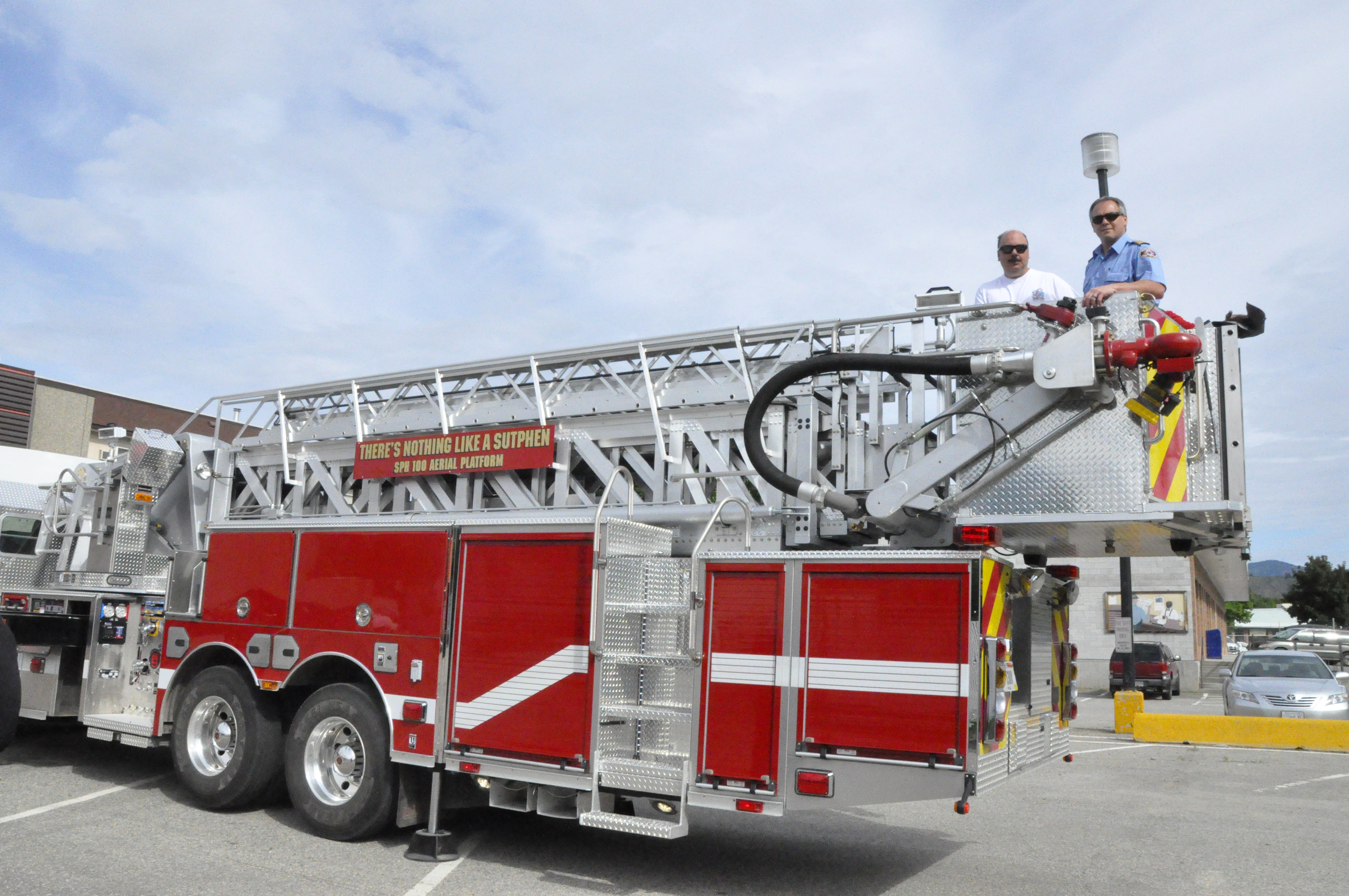 Grand Forks Fire Rescue is looking to purchase a new fire engine to replace the department’s older vehicle.
Dale Heriot, Grand Forks Fire Rescue chief, noted that the new fire engine would be replacing an older engine by next year.
“We are looking to replace our current fire engine truck by the end of 2013,” he explained. “As a fire department, when we purchase equipment we don’t purchase it for where we are today, we purchase it for what we figure will happen 20 years down the road because they last us 20-plus years.”
Heriot is hoping to have a fire engine ordered sometime next year because it takes up to a year to custom build each fire engine.
“It’s not like a car lot where you can just pick one up, most times you have to order them and they build them to your specifications,” he added. “We are looking at replacing our current ladder truck with a 100-foot (about 30.5 metres) ladder truck.”
Part of the reason the Grand Forks Fire Rescue is looking at a ladder truck is due to the possibility of a developing city.
As the area continues to grow, Heriot pointed out that there might be a chance of the population doubling within the next 20 years.
“We have to speculate this way because if we didn’t and it did double, and we’re not prepared for it, we can’t protect the community properly,” Heriot said.
Another reason has to do with Roxul Inc.’s expansion and Interfor upgrading its facilities. The 30.5-metre ladder would allow the firefighters to reach a higher elevation for a water stream to protect the facilities.
At the moment, the tallest ladder the fire department has is 15 metres long, so the additional height of the ladder is also being considered for its added reach.
“The new Silver Kettle Village is a big development and for us to manage a rescue, we need to be able to reach into some of those third storey balconies to get people,” explained Heriot. “With anything shorter, it will be really tough to get into there when you take into account landscaping and everything else.”
The new fire engine would include a platform ladder, as opposed to a regular ladder. A platform ladder has a basket-like box attached to the top of the ladder, that also provides better stability for firefighters when rescuing someone from a building.
“What we currently have is an aerial ladder, so only one person can climb up it,” Heriot pointed out. “We feel with the amount of seniors that we have in the community, it’s pretty hard to get a senior out of a burning building and climb down our current ladder. If we had a platform with a basket, we could just step them into the basket and bring them down. It’s much safer for everybody.”
Despite the plans for a new fire engine, the price of the fire engine is still under discussion.
“The reason why the price is still up in the air is because it depends on what size of a truck you’re going to get and what other options you get on the truck,” said Heriot. “The price can go anywhere from $700,000 to $1 million, but it’s all dependent. It’s also dependent on taxpayers.”
The fire department hasn’t asked the city for money yet, as planning for the new fire engine is still underway.
Mayor Brian Taylor believes the new fire engine will be a great asset to the city.
“It looks like an expensive investment by the city and frankly we don’t have enough in reserves to cover it so we’ll have to look into other sources,” said Taylor. “The purchase of the new fire engine is also a matter of primary responsibility of safety to the city.”
Taylor also agreed with Heriot that the new ladder would be helpful for newer buildings like the Silver Kettle Village.
Heriot noted that at this point it will be fully funded by the city, but they do have an agreement with Rural Fire Protection District.
The Rural Fire Protection District was created in 1957 and asked city firefighters to operate outside of city boundaries. Rural Grand Forks created their own fire rescue group in 1979, but both the city and rural teams were amalgamated in 2006.
“Ultimately, it really is up to the taxpayers and what they want,” he concluded.
Grand Forks Fire Rescue currently has six fire engines, with 11 apparatuses that include water tenders and other equipment. There are five fire halls spread throughout Grand Forks and the rural area.
The new fire engine would include a platform ladder as opposed to a regular ladder. A platform ladder has a basket-like box attached to the top of the ladder, that also provides better stability for firefighters when rescuing someone from a building.
“What we currently have is an aerial ladder, so only one person can climb up it,” Heriot pointed out. “We feel with the amount of seniors that we have in the community, it’s pretty hard to get a senior out of a burning building and climb down our current ladder. If we had a platform with a basket, we could just step them into the basket and bring them down. It’s much safer for everybody.”
Despite the plans for a new fire engine, the price of the fire engine is still under discussion.
“The reason why the price is still up in the air is because it depends on what size of a truck you’re going to get and what other options you get on the truck,” said Heriot. “The price can go anywhere from $700,000 to $1 million, but it’s all dependent. It’s also dependent on taxpayers.”
The fire department hasn’t asked the city for money yet, as planning for the new fire engine is still underway.
Mayor Brian Taylor believes the new fire engine will be a great asset to the city.
“It looks like an expensive investment by the city and frankly we don’t have enough in reserves to cover it so we’ll have to look into other sources,” said Taylor, who added long-term leasing would be the city’s first choice. “The purchase of the new fire engine is also a matter of primary responsibility of safety to the city.”
Taylor also agreed with Heriot that the new ladder would be helpful for newer buildings like the Silver Kettle Village.
Heriot noted that at this point, it appears it will be fully funded by the city but the situation is under negotiation with the Rural Fire Protection District. The Rural Fire Protection District was created in 1957 and asked city firefighters to operate outside of city boundaries. Rural Grand Forks created their own fire rescue group in 1979, but both the city and rural teams were amalgamated in 2006.
“Ultimately, it really is up to the taxpayers and what they want,” he concluded.
Grand Forks Fire Rescue currently has six fire engines, with 11 apparatuses that include water tenders and other equipment. There are five fire halls spread throughout Grand Forks and the rural area.
City of Greenwood won’t take over Providence Dam
 At its last council meeting on July 9, the City of Greenwood decided not to take over responsibility of Providence Dam located at Marshall Lake.
Greenwood Mayor Nipper Kettle explained that the lake is not the city’s responsibility.
“We are not willing to take over ownership of the dam, there’s just too much risk involved and too much liability,” he said. “The ‘what ifs’ are just too great, especially when you look around now at what’s going on around British Columbia. It’s not the same, but it is a concern.”
Kettle is referring to the mudslide at Johnson’s Landing, as well as the mudslide near Fairmont Hot Springs Resort, north of Cranbrook.
Greenwood council made the unanimous decision prior to the July 13 deadline imposed by the Ministry of Forest, Lands and Natural Resource Operations.
“Personally I think the dam is safe, but it’s hard to say with what’s happening now,” said Kettle. “I do know that we can’t afford to take it on and it’s not our responsibility.”
Tara White, senior fisheries biologist for Fish and Wildlife Section of the Ministry of Forests, Lands and Natural Resource Operations out of Penticton, stated that the removal of the dam was the ministry’s first option.
“We’re currently conducting a feasibility analysis of the costs and logistics, design options and timeline schedules to decommission the dam,” she said. “When the feasibility analysis is complete, there will be considerations to look at.”
White pointed out items could include where the dam should be breached, to what level, where the best spot would be, and the implications to the landowners. The Fisheries and Wildlife Section only owns the lake and not the surrounding property.
“After the feasibility study is concluded, we will be consulting with adjacent landowners for potential impacts and that their concerns are
addressed,” said White. “The feasibility study should be done within the month.”
Christopher Stevenson the founder and organizer of the Marshall Lake Stewardship Society, said, “At this point we have to wait and see what steps the Ministry will take.”
He added, “At a certain point we are going to have to make a decision and say, are we going to allow them to go in with excavators to take it out or are we going to do something about it?”
Stevenson noted the stewardship society is looking at several possible appeals, including the loss of property value. He recently found a separate case study surrounding this issue that describes an aspect of the situation he believes the ministry hasn’t taken into consideration.
“As soon as they do something to this lake and make their lakeshore into mud, their property value will spiral down,” he pointed out. “The ministry will have to compensate them.”
Diane Gottselig, the property owner, who has a cabin located near the lake, wrote a post on the stewardship society’s Facebook page stating the low water levels over the past few summers have made it difficult for them to access their cabin.
“We have to walk across a huge ditch with over a foot of water in it,” she wrote. “We have not been contacted with plans for how we will be able to access our property this summer. The property was bought with the certificate stating lakeshore property.”
She noted that should the lake be reduce to its original state, all that would be left is weeds and mud on their side of the lake.
“This will make it unable for us to swim, use the beach and just generally difficult to enjoy the property,” Gottselig said. “We use the property very frequently and have a lot of family and friends who enjoy it with us.”
Gottselig is also concerned about how the reduced lake size would affect the animals that use or live there.
In less than a week, the stewardship society has collected more than 800 signatures for a petition. The signed petitions were delivered to the Forests, Lands and Natural Resource Operations Minister Steve Thompson, while the online petition will be forwarded to Premier Christy Clark.
“The feasibility study should be done within the month.”
Christopher Stevenson, the founder and organizer of the Marshall Lake Stewardship Society, said, “At this point we have to wait and see what steps the ministry will take.”
He added, “At a certain point we are going to have to make a decision and say, are we going to allow them to go in with excavators to take it out or are we going to do something about it?”
Stevenson noted the stewardship society is looking at several possible appeals, including the loss of property value. He recently found a separate case study surrounding this issue that describes an aspect of the situation he believes the ministry hasn’t taken into consideration.
“As soon as they do something to this lake and make their lakeshore into mud, their property value will spiral down,” he pointed out. “The ministry will have to compensate them.”
Diane Gottselig, the property owner who has a cabin located near the lake, wrote a post on the stewardship society’s Facebook page stating the low water levels over the past few summers have made it difficult for them to access their cabin.
“We have to walk across a huge ditch with over a foot of water in it,” she wrote. “We have not been contacted with plans for how we will be able to access our property this summer. The property was bought with the certificate stating lakeshore property.” She noted that should the lake be reduce to its original state, all that would be left is weeds and mud on their side of the lake.
“This will make it unable for us to swim, use the beach and just generally difficult to enjoy the property,” Gottselig said. “We use the property very frequently and have a lot of family and friends who enjoy it with us.”
Gottselig is also concerned about how the reduced lake size would affect the animals that use the lake or live there.
In less than a week, the stewardship society has collected more than 800 signatures for a petition. The signed petitions were delivered to the Forests, Lands and Natural Resource Operations Minister Steve Thompson, while the online petition will be forwarded to Premier Christy Clark.
Claim could allow North America Stone to remove 10,000-ton bulk sample
 The Ministry of Energy and Mines had an information session at Gallery 2 on July 5, after hearing about public concern over the possibility of two exploration projects.
North America Stone has applied for two exploration mining permits, one near Lynch Creek and the other by Granby River.
Residents who live near the site are worried about the damage that may occur to the surrounding environment, such as blockage of wildlife corridors and the impact on at-risk species, such as the red-listed clover and Peregrine falcons.
The information session included maps of the sites, notice of work application, and environmental and reclamation plans.
Al Ludwig, a mining consultant from the Ministry of Energy and Mines, pointed out that usually, the request for public involvement comes into play after a mining application is approved.
“The permit has not been approved yet and they indicated that they would be taking a much smaller sample to test the feasibility of it,” he said. “There are still several steps along the way.”
Ludwig explained that the mineral claim would allow North America Stone to remove up to a 10,000-ton bulk sample every five years.
“If the company goes beyond that, they have to apply for a mining lease and a mining lease will then give them the right to remove more than the bulk sample,” he added. “The development depends on the company and whether this bulk sample is their objective. If it does, they may go towards buying a lease and it becomes a quarry, rather than a mineral exploration quarry.”
Prior to the information session, Ludwig hiked up the hill to determine the situation and said that the site location is a several kilometres from the creek.
“There are still some outstanding issues that have to be addressed and if the company present those and no other technical concerns come up, they may start sometime within the next month,” he said.
Rick Mitchell, a surveyor from Discovery Consultants Ltd., who was the purveyor for North America Stone, stated that Discovery has worked before in Grand Forks for mining purposes.
“This permit is about taking a bulk sample to evaluate the property. Discovery came out, prospected North America Stone’s area and we picked the two sites that had the least fractured stones,” Mitchell explained. “If the rock is heavily fractured, even if you drill it in it doesn’t stay intact. We picked the locations that had the least amount of fracturing based on what we surveyed.”
Mitchell pointed out that the first step is to get the permit and then next is to get the contractors to see what’s best for North America Stone and most cost effective.
“We do have water management plans put into place,” he added.
“The south site has silk canvases, we’ll be putting fences and ditches in, and there’s already existing culverts that we’re going to protect. I do not see any impact to the water because everything will be contained. There isn’t going to be much silt produced.”
Silt is a granular material like sand that is produced during some mining processes. As well, Mitchell noted that the company would not be blasting any rocks in order to reduce the amount of stress fractures in the rock.
“The company will be using Crack It gel, which is a calcium-like cement that is poured into drill holes and fractures the stone within a matter of hours,” he said. “It isn’t hazardous to the environment, since it is reduced to a dust that contains natural elements.”
North America Stone Logistics Co-ordinator Rocky Sun from noted that the company does have several sites in British Columbia.
“We have applied for a permit to get some samples to see if it will be good for the market,” he explained. “It’s to see if the quality is good enough for the market before we apply for another permit for another duration.”
The sample, if it meets the company’s standards, would be used for marble.
“We will then send it back to China for polishing and processing for items such as countertops,” Sun said. “I don’t think there’s any secrets about the company. We just want to get a sample from the site to test whether it’s good or not.”
Ludwig noted that North America Stone has requested a qualified biologist to assess the site for any species, however, he pointed out that both permits haven’t been approved.
“There are still some outstanding issues that have to be addressed,” he said. “I would suggest that if anybody is concerned about the site that they hike up there and visit the site. The Lynch Creek site is a good location because it’s far enough away from anything, there are trees between them and there’s an access road already there. That’s considered a good location with good access compared to the other one because the other one there are some concerns.”
 Snap. Flash. Smile.