Author Archives: Cassandra Chin

Hamilton flight school takes to the skies

A local flight training company is taking off at a steady pace after initial turbulence when it first launched a year ago.

REDBIRD FMX-1000 full motion flight training device.

REDBIRD FMX-1000 full motion flight training device.

With its popular in-house flight simulator and Cessna 172, Golden Horseshoe Aviation continues to grow by filling a niche of interested aviators and those who wish to take to the skies.

Located in JetPort’s facility (Unit 520, 9300 Airport Road) at John A. Munro’s Hamilton International Airport, the REDBIRD FMX-1000 full motion flight-training device has drawn aviators from all over the world.

The simulator was purchased eight months ago at a cost of $85,000.

“The advantage is that it doesn’t use any fuel, insurance is much less and it flies no matter what the weather is outside,” said Chief Flight Instructor and co-owner John Maxwell. “If a student is scheduled for every Tuesday afternoon, on days with bad weather there are a lot of lessons that we can do in there.”

“One of the capabilities of it is that an instrument rated (qualified) pilot has to renew their ratings every two years,” said Maxwell. “Traditionally this is done in a multi-engine airplane at $350-$400 an hour, rented by a pilot for several hours to brush up, before a flight test is completed for the examiner.”

Along with examiner fees, the cost to renew a pilot’s license in Canada can add up to thousands. However, testing can now be completed on the ground, in house and with an in-house examiner for $599.

It was in 2011 when Maxwell and the Chief Executive Officer Michael Geraghty flew past Hamilton’s airport and Maxwell noted the size of the airport and the city.

Maxwell was quick to point out Hamilton didn’t have its own flight school. The last time Hamilton had its own flight school was in 2008.

“Soon the conversation turned into an idea, then into business and then a business plan,” said Maxwell, adding the process took about a year.

The company has four instructors though they expect to hire a few more by the end of the year to teach the growing number of students. There are around 30 students at the moment.

Chief Flight Instructor John Maxwell with the Cessna 172.

Chief Flight Instructor John Maxwell with the Cessna 172.

As the company gears up to celebrate its first anniversary on May 1, the flight instructor noted they are in the process of importing a Diamond DA-200 to add to its fleet.

“It’s a really fun two-seat plane that comes with a canopy on top that provides a panoramic view,” he said. “We liken the Cessna 172 to taking your dad’s pickup truck, while the Diamond is like borrowing mom’s convertible.”

The new airplane will open up another avenue because it appeals to another market base.

In five years, Maxwell hopes to see his fleet expand to eight to 10 airplanes.

“We want to draw more general aviation to the Hamilton airport because there’s not a lot of small piston powered airplanes in this airport,” he said. “We hope to be an anchor tenant here and attract some of that attention back.”

Samantha Mincone, a student at the centre, spends a lot of time at the centre but noted training can be taken at your own pace.

As someone who has always been interested in aviation and planes, Micone looked up the flight school and signed up.

“I like that this is at a large airport too, because you get to deal with the big planes as well as the smaller ones on the runway and in the air,” she said. “It’s great to be able to speak with the tower and you’re able to learn quickly.”

She hopes to complete her flight certification in a few months. Transport Canada requires a mandatory 45 hours flight training as a minimum before certification, but Maxwell noted students should budget for 60 hours.

According to statistics, the national average is around 55 hours of flight training.

Time in a flight stimulator can amount to five hours, though students are also required to complete at least 40 hours of ground school training.

“We use computer based training modules, the flight simulator, teach in the boardroom with small classes, and take them out flying as much as we can,” said Maxwell.

Students can fly with a student pilot permit, which means they are able to fly solo with supervision.

Originally posted in Your Hamilton Biz.

Tagged , , ,

Hamilton bra school aims for prime time TV

And it’s a cut.

DSC_0119

Beverly Johnston (centre) teaches some students how to make a corset.

Hamilton’s Bra-makers Supply is aiming for the stars with its own television series on prime time.

As the only teaching program of its kind in the world, Bra-makers Supply attracts international attention from individuals who flock to Ottawa Street North to take courses.

But last year, owner Beverly Johnson had a visit from someone looking for something else.

“We were approached to create a reality TV show about the school and the store, which I thought was a great idea because it would educate people about the needs of creating your own bra,” explained Johnson, also known as the Fairy Bramother.

Almost a year after the initial pitch, Lifetime, a small U.S. network, launched Atlanta-based Double Divas and Johnson knew she had to pitch the idea again.

The idea for the TV series would be pitched to Slice TV sometime this week.

“At the time it was pitched to all the women’s networks but it was turned down,” she added.

Where the front of her store sells top quality, professional and bra-making supplies, her backroom is a classroom where she teaches individuals how to make intimate apparel, including bras, corsets, underwear, swim wear and body shapers. The store itself has attracted students from all over the world.

Courses range from the one-day underwear ($100) to a 10-day corsetiere’s course ($1,000). The Made-to-Measure Bra-Making course for advanced students runs nine weeks, at five days a week and attracts individuals from Italy, Sweden, England and Africa.

Johnson estimates she has taught more than 10,000 women, from accountants to doctors to waitresses.

Bra-makers Supply opened 14 years ago and sales and interest have steadily increased.

Internet purchases and online requests are the biggest part of her business but classes and walk-in traffic have also increased over the years. In its first year, she noted it grew 50 per cent from $18,000 and another 30 per cent in its second year.

As her business stabilized, she noted it still continues to increase 20 per cent on average per year.

“Now classes alone account for $80,000,” said Johnson. “After I wrote my first text book (roughly 200 pages in December 2005), sales doubled. After each publication of my text book or patterns, sales will always jump.”

Tallying over 500 pages in total, Bra-makers Manual Vol. 1 and Vol. 2, along with her other books and her Pin-Up Girl Patterns have been translated to French and German.

Wendy Chisholm, owner of Elegant Silhouettes in London, Ont., noted she heard about the bra-making store after taking a course from a former student of Johnson’s.

“I love to sew and I can never find a good fitting bra so I thought I would give it a shot,” said Chisholm.

Taking the course for the first time on how to make a corset, Shayla Notman, 19, aims to use this experience in her own store, Smitten.

“It’s a really good pace,” said Notman, whose store opens on May 3 and features vintage-inspired clothing. If you know a lot about sewing and construction, you can go as fast as you need to, but if you need help you’re welcome to ask questions. It’s a comfortable atmosphere and really awesome to be in a class with three people.”

Along with teaching her classes, Johnson will be heading to Alaska next month with 80 students to teach a course, as well as Sweden in August for two weeks.

Originally posted in Your Hamilton Biz.

Tagged , ,

Downtown Hamilton stars at annual BIA conference

Downtown Hamilton’s business improvement area and the resurgence of the core were stars during the annual Ontario Business Improvement Area Association (OBIAA) conference in Toronto.

A key conference seminar celebrated Hamilton’s achievements and gave BIAs around the province a chance to see how renewal can lead to success, said the director for Renew Hamilton Project.

This year’s conference is themed around building the local economy.

“BIAs are the very best at building what we call a Main Street Economy,” Richard Allen explained. “All communities of all sizes typically have a BIA and their sole focus is on developing and supporting businesses. The notion of economic development and local economy, and using revitalization techniques are very compelling.”

Hosted by the OBIAA and the Toronto Association of BIAS (TABIA), the conference began on April 14 and goes until April 17.

It is being held at the Toronto Marriott Downtown Eaton Centre Hotel. Fifty delegates from BIAs across Ontario learned about the goal and purpose of the Renew Hamilton Project, which is to document, promote and accelerate the restoration and regeneration of downtown Hamilton and the adjacent communities, Allen said.

“Many of the small towns across Ontario are struggling to maintain, build and grow downtown populations, and many downtowns are also struggling both to preserve and restore their heritage buildings,” he explained.

“Those that are finding a way to do it, are finding a renewal premium on those properties.”

The rejuvenation of an area leads to an increase in property values, more foot traffic and unique stores.

It is also important that BIAs are able to differentiate themselves from other areas, added Allen.

“We were able to discuss many things and play two case study videos about the revitalization of the Gore area,” he said. “The videos proved to be great conversation starters and we had a great discussion. In the end, many people felt that Hamilton was already in front of many other communities when it comes to regeneration of its downtown.”

The reaction to Hamilton’s success was positive, with many people commenting on how the downtown revitalization has started to generate economic and social spinoff.

Other BIAs in attendance noted Hamilton has some techniques and policies that could be applicable to other communities, including the grants and incentive programs, said Allen.

There are more than 280 BIAs representing 55,000 businesses in Ontario.

Other seminars discussed the new accessibility standards, improving event management and streetscape renewal.

Awards are being handed out Wednesday in categories including Marketing and Communications, Business Retention, Recruitment and Expansion, Special Events and Promotions, Safe and Healthy Environment, Bricks and Mortar, and the Alex Ling Lifetime Achievement Award.

Originally posted in Your Hamilton Biz.
Tagged , , , ,

Energy boosting and healthy, Gojiccino enters cafes

It took four years to perfect Gojiccino, but the healthy, energy boosting drink is one of a kind.

Based in Ancaster and manufactured in Guelph, food developer Jennifer Low says her product is a non-caffeinated drink full of nutrients.

Jen Low creating a batch of Gojiccino.

Jen Low creating a batch of Gojiccino.

Small, red and football-shaped, the goji berry was a culinary staple for Low growing up. What was once used in traditional Asian meals, the goji berry has become popular and can now be found in grocery stores, such as Fortino’s or Loblaws.

The berry, used in soups or steeped in teas, can now be put into lattes and cappuccinos.

It was through her varied career around the food and communications industry, she was most recently a food editor for Canadian House and Home, Low was reintroduced to the goji berry when she was visiting California.

The idea to create something with the goji berry was ignited through a conversation with several food journalists about the growing interest in the berry.

“As a food editor, I received press releases coming in from people who have new products and I always knew I wanted to develop my own product but it had to be something that people wanted and needed,” she explained.

It started as an artisanal product and Low had to rethink her approach when it came to making it a mass commercial product.

“This meant using different equipment and thinking about the methods in a different way,” she said. “In order to get your product up to large commercial product, as the developer I have to maintain my idea of what the essence of the beverage is. I can’t lose sight of it because it’s too easy to have it morph into something else.”

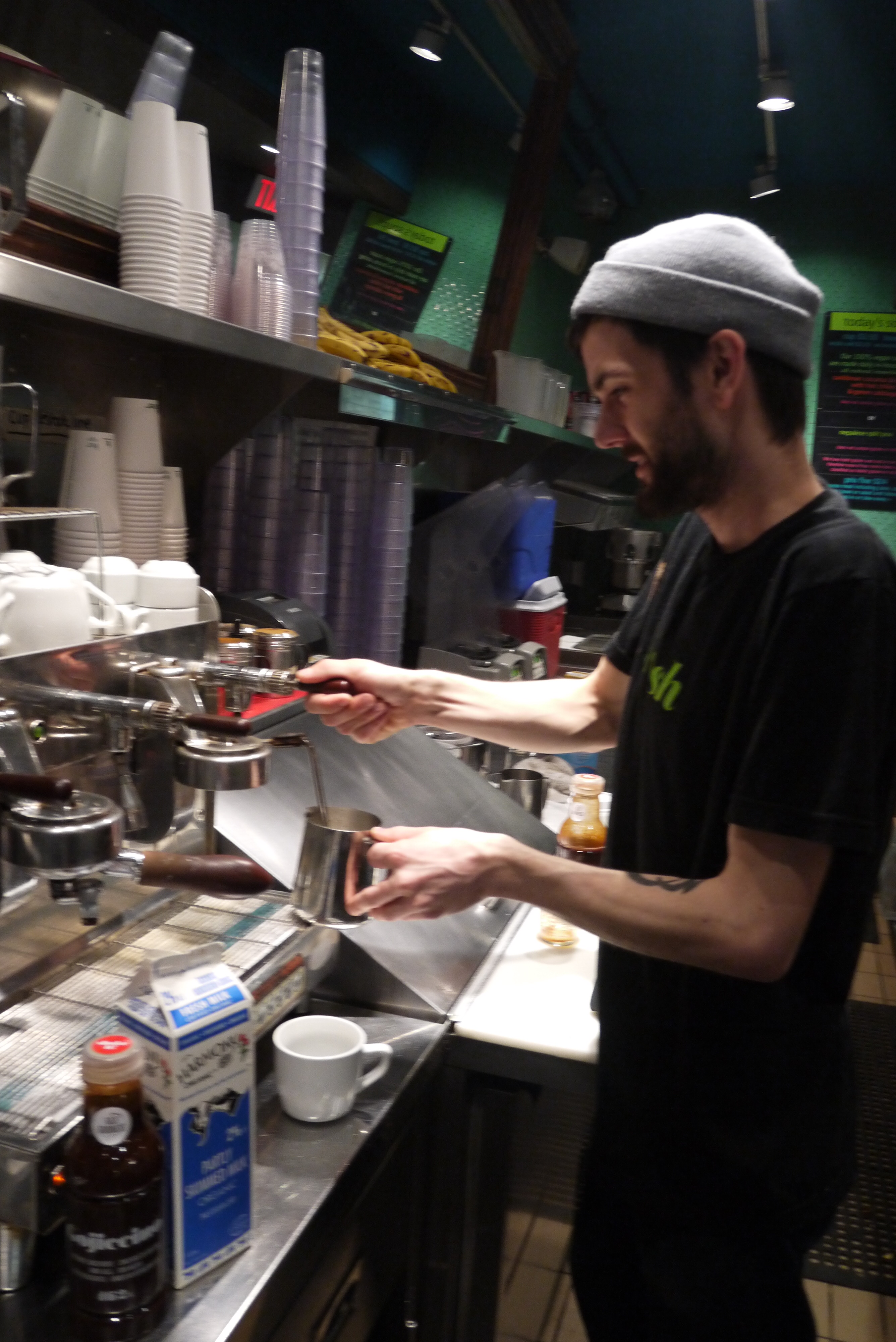
A rich, dark liquid, the Gojiccino concentrate can be mixed with any type of milk to make a Gojiccino or Gojilatte. People can also choose to drink it plain, with a dose of sweetener, or as shots that can be added to brewed coffee.

“Think of it as goji espresso in a bottle, so baristas use the concentrate, froth it with any type of milk, and turn it into a latte styled drink,” said Low. ”It’s like a mochacinno with an herbal finish.”

People who don’t know what a goji berry is associate the drink and its taste to something sweet, but it’s not, she said.

“Everybody who tastes it will come up with something different,” she said. “I’ve had people tell me that it tastes like a pumpkin latte but less sweet, or it has a malty taste.”

There is no pumpkin or malt in the concentrate.

Along with regular Gojiccino patrons, each day sees new customers trying out the drink, noted Holly Gibb, a manager at Earth to Table Bread Bar on Locke Street.

A barista adding Gojiccino to a drink.

A barista adding Gojiccino to a drink.

“We have people who come back for it every time and it’s a nice alternative to a caffeine drink to give you energy in the morning,” she said. “We always like trying new things to give our customers to see what they like and what they’re asking for.”

Gibb noted Gojiccino adds an earthy taste to drinks and is quite filling.

“We sell it as an alternative to a caffeine beverage, similar to a protein drink because it’s filling and gives you energy for those who are working out,” Gibb added.

The drink is for anyone, from those who don’t drink coffee to those who have already had two or three cups and want a drink without caffeine.

It’s also for those who are looking to incorporate healthier foods into their diet, said Low.

Toronto’s Fresh restaurants will be offering the concentrate starting this week. Gojiccino can also be found at The Red Brick Café in Sundridge in Northern Ontario.

In three weeks, Gojiccino will be served in Toronto’s The Big Carrot, a natural food market and organic juice bar.

Originally posted in Your Hamilton Biz.

Tagged , , , ,

New businesses a bright light on Barton Street

It’s been slow going but the upswing on Barton Street was one of the reasons Maria Daniel decided to open her creperie there.

Maria Daniel making a crepe.

Maria Daniel making a crepe.

Hargitai’s, her Hungarian maiden name, will be celebrating its first year on April 13 and though it faces the same challenges of all businesses in its first year, Daniel stands by her choice of location.

“There’s no denying the real estate is much more affordable here than anywhere else,” she explained. “I also look at it from a sentimental perspective. This area needs happy things and legitimate business, as well as people who are willing to take the risk and jump in.”

Located at the heart of Barton Village (304 Barton Street E.), Daniel noted the street has already improved but there is a long way to go.

“This area didn’t get like this over night and it’s sure not going to fix itself overnight either,” she said. “Some people have a pre-conceived notion about Barton Street and because of this, they don’t want to come to Barton Street but I strongly urge them to overcome those notions and give this area a chance.”

Developers from Yoke Group Inc. are also hoping renovations to a recently purchased building will slowly shed the negative view people have of the street.

Anthony Quattrociocchi and Eric Cardillo of Yoke Group Inc. inside their newly renovated building on Barton Street.

“It’s not like we’re buying here expecting miracles to happen overnight, but we see potential with the growth here and we hope to bring proper businesses back into the area,” Anthony Quattrociocchi said of Barton Street.

Anthony Quattrociocchi and Eric Cardillo of Yoke Group Inc. inside their newly renovated building on Barton Street.

Anthony Quattrociocchi and Eric Cardillo of Yoke Group Inc. inside their newly renovated building on Barton Street.

Decisions are based on a five-year outlook and where the company believes a location will be in five years, he explained.

Much of the properties on Barton Street have been left alone without maintenance over the last 10 to 20 years, Quattrociochhi added, but they remain in their natural state.

“We look for nice buildings that we think we can bring back to life and Barton Street has a lot of those buildings,” he explained. “We want to get the ball rolling. When people see you doing the renovations it entices them and makes them look at their building.”

The 12 unit building was bought on Nov. 1 last year with renovations completed late January. It has four commercial units and eight residential rooms that features two bedrooms, 10-foot ceilings, and over 1,000 square feet of space.

A bicycle repair shop is slated to open on April 1 in one of the commercial units, but there is already a waiting list for the residential apartments. His partner Eric Cardillo noted development on the street is slow but it’s very similar to what occurred on Ottawa Street and what’s currently happening on James Street.

Two small businesses that have been on the street for over 50 years welcome the sight of new development.

With its butchered meat and freshly prepared sandwiches, Duartes’ Supermarket has been a corner store staple for many families and blue-collar workers.

Alcino Duarte, who intends to take over when his parents retire, noted much of the changes on the street are also reflected in the population.

Twenty years ago Duarte recalls most of the residents were Italian, while 10 years ago the population was mostly Portuguese. Now the community has become a mixed culture as the Portuguese families move out to the more urban areas.

DSC_0070

Victor Duarte (left) and Alcino Duarte (centre) with their
friend Victor inside Duartes’ Supermarket.

“Duartes’ still offers the same prices as 20 years ago and the price increases hasn’t been reflected in our store,” he explained. “Barton Street is an area that has a lot of low-income families, including problems with drugs and prostitution… but recent changes such as the banners hung from the side of light posts, are good for the community.”

In operation since 1915, Kenesky Sports and Cycle has seen the transformation that has occurred on Barton Street.

“It was good back in the late 60s and early 70s, then it became crappy before it came back a bit,” explained owner Joel Hulsman. “It went (downhill) again when the Wesley Centre opened up, which is a drop-in centre for the homeless.”

However, Hulsman noted things are starting to change with the addition of the hospital, the upgraded elementary school, and new businesses on the street.

“The upgrades (Yoke Group) did to the building have been great,” Hulsman said. “In five years, Barton Street is going to be vibrant.”

Barton Village BIA Executive Director Shelly Wonch believes the area is heading in the right direction.

“We’re really on a roll and we’re in the right direction even if there’s a long way to go. We have to deal with the business owners with buildings that are all boarded up,” she said. “We have to get the landlords to take responsibility, gain an interest and fix up their buildings.”

Though the street has always been a launching pad for Hamilton, there hasn’t been too much activity in the real estate market around the area, said President Elect Tim Mattioli of the Realtors Association of Hamilton-Burlington.

“Barton Street will always be there and have its own strength but that changes with each generation,” he said.

Hamilton’s downtown core is an example of what can be done to rejuvenate Barton Street, when blocks of properties are bought and either rebuilt or repurposed, explained Mattioli.

“It’s hard to rejuvenate a place without development,” Mattioli said. “One of the biggest problems is that people believe Barton Street is a dangerous place, but it’s not. The beauty of Barton Street is that it maintains the neighbourhood vibe lost in many urban areas.”

People tend to think progress has to be big and shiny, but that’s not the case, he added.

Originally posted in Your Hamilton Biz.

Tagged , , , ,

Academy of Osteopathy has set up a shop on Ottawa Street

The 140-student Canadian Academy of Osteopathy has set up shop on Ottawa Street.

Academy principal Robert Johnston launched the school on Melvin Avenue in 2003 but when he decided to expand he looked to Ottawa Street.

“I’ve had great support from the community over the years and (Ottawa Street) is going to be one of the most important streets in Hamilton in several years,” he said, noting as a Hamilton native, he is committed to his hometown. “I’ve been asked more than once to move the school to Toronto but I’ll be keeping it in Hamilton.”

A former Canadian Tire at Ottawa and Dunsmure has been converted to classroom space.

Osteopathy looks at the relationship between the anatomy and the physiology of the human body. Students are taught to address the anatomical and physiological reasoning for problems, and to choose the appropriate technique to address it.

There are currently around 140 students from around the world enrolled with the school. Students have the option of enrolling in September or April, with a 12-month rotation of six months in class and six months of clinical training.

Prior to becoming an osteopath, Johnston was a massage therapist looking for treatment for a neck condition that had ailed him for several years.

He attended an osteopathy session with Dr. Alfred Reid Johnston in Waterdown and issues he had disappeared.

“I was blown away by his ability to rectify the problem that had bothered me for years,” Johnston said, noting he shortly thereafter started educating himself about osteopathy in the United States and the United Kingdom, before returning to Canada.

Johnston studied under one of the founding fathers of osteopathy, John Wernham. As an independent school that maintains its own autonomy, the staff remains accountable for what students learn, he added.

There are various options for those interested in attending osteopathy classes, from entering straight from high school to pursuing it after completing an undergraduate degree.

The 1:4 to 1:6 teacher-student ratios also allow for individual attention for students to learn in a close-knit classroom for four years of learning, with an option to extend classes to five years.

The Canadian Academy of Osteopathy also operates out of the Melvin campus, using its rooms for practical workshops and a student clinic. The student clinics are free to the public, and patients can drop in more than once for ongoing care.

Students are required to complete 1,000 volunteer hours as a part of their studies.

“We are very dedicated to community-based services, and this is one of the ways we give back to the community,” said Johnston. “I’m very committed to bringing Hamilton forward and having the (academy) in Hamilton is to give the city recognition.”

Originally posted in Your Hamilton Biz.

Tagged , , ,

Vacant Beachway Park pump may see business in Burlington this summer

Built in 1909, the Beachway Park pump house in Burlington may once again see residency as the city opens it up for seasonal rent.

The City of Burlington has put out a proposal inviting businesses to submit an application for a rental opportunity for the historic pump house at Beachway Park (1094 Lakeshore Road).

Businesses would be able to occupy the building for seasonal rental from spring to fall.

There are already four submissions, noted Jim Seferiades, a business services planner for the City’s Parks and Recreation department.

“Those proposals include food service, retail and recreational rentals, though right now the food service is out of the equation because there is no water or sanitary systems available,” he explained. “We’re leaning more towards retail and recreational or leisurely services to fill the space.”

The 800-square-foot building has been used as a storage facility for the city since it was purchased in 1987, but remained mostly unused for the past 15 years.

Prior to the city purchasing the pump house, it was used as a residential home with a full basement and an additional 200-square-feet used for a kitchen.

“The building right now will be rented with limited amenities since the sanitary system isn’t functional,” Seferiades explained. “Therefore there is no water because it can’t go anywhere. It will be based on hydro power, so there’s no heating or cooling.”

The City plans to spend around $10,000 for minor upgrades such as fixing cracks in the wall, cleaning up the old washroom facilities and outdated fixtures, as well as painting the walls.

“Because the building will be used for seasonal rentals, when the business isn’t there in the off-season we can go in and do the bigger upgrades,” he said, noting it includes installing a furnace. “We’ll stage the improvements through a phased approach during windows of opportunity and offer it as a full season sort of rental for the longer term once its done.”

The majority of the $62,000 budget that had been approved in the city’s capital budget for this year will be saved for long-term upgrades, though it doesn’t include the renewal of the septic system.

The completion of the sewer system would be determined once the results of the Beach Master Plan and Servicing Study is announced during the Community Services Committee on April 17, said Karen English, a senior buyer for the city of Burlington.

When the new septic system is installed, it would be adjacent to the beach pavilion beach septic system that is directly connected to the Skyway Wastewater Treatment Plant; however, the current system would not be able to handle additional flows.

The Beach Master Plan would allow the city to plan a comprehensive solution for sanitary services in the area.

A decision should be made by the end of April on which business or organization will be chosen, added English.

“Interested parties are required to purchase the RFP document and submit a compliant proposal,” she said, with applications due on April 11 at 2 p.m. “We hope to generate revenue, better utilize a unique heritage asset, create a destination on the beach and create a more dynamic beach environment with opportunities for citizens.”

The upgrades to the building is expected to be complete by May 1, with the latest day projected to be the Victoria Day long weekend, so businesses can move in for the season.

Tagged , ,

BinPad hopes to clean up at Dragon’s Den

Mushed newspapers, empty cans and scattered debris is a common site after a windy day.

A windy day leaves recycling bins scattered on the streets.

A windy day leaves recycling bins scattered on the streets.

Sometimes a good Samaritan will be kind enough to pick up the trash, but more often then not, city workers are tasked for clean up duty – at a cost.

It’s that cost to taxpayer’s that had a local man come up with the BinPad Product, an innovation that has entered the Dragon’s Den.

“In February, we attended a open audition for CBC’s Dragon’s Den and are currently waiting for the call back for production filming,” explained Steve Onland. “At this point we are hoping that the Dragon’s Den will prove positive for the product, as well as allowing a business plan and marketing company to take over.”

As a horticulturalist for the city, Onland often provides help in litter cleanup during the offseason or winter months.

Over the last few winters, he found that he and his co-workers spent too much time and taxpayers dollars cleaning up debris from tipped over recycling boxes and garbage cans.

“I began to research and prototype a solution that would assist in keeping these receptacles standing at the curb and reducing the amount of garbage and recycling litter in our city,” he explained.

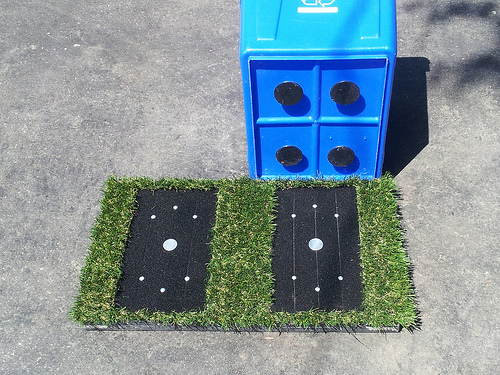
The BinPad Product is a simple design, yet effective.

The BinPad Product is a simple design, yet effective.

As he looked into creating a prototype, Onland realized there were some major factors that had to be addressed.

“We needed something that would at no time be a hazard or above ground level that would be a liability for residents as well as the municipality,” he said. “We also needed a product that was well built and could withstand temperature changes, as well as not be a eyesore to the public and landscape of our boulevards.”

Another issue was coming up with a product that would be acceptable to the garbage and recycling collectors and wouldn’t hinder their job.

The implementation of BinPad into the city’s garbage services would have major benefits, including cost savings, he added.

Simple in design, the BinPad are small pucks that are attached to the bottom of a recycling bin or garbage can. After an artificial turf is attached to the ground that matches one’s property, the bin will stick to the turf (similar to Velcro) so it won’t fly around on a windy day.

“I have used Hamilton as the springboard for introducing the BinPad and also for hearing what our residents think about the concept and prototype. Most are interested in the product and do see that we need an improvement to the current system,” Onland said. “I have also spent some time speaking with the waste and recycling employees in the city to see if there would be any fallbacks to them using the product on a daily basis.”

Onland noted there has been a small amount of BinPads built for pilot programs, with the hope it becomes visible at public home shows and locations later this year.

Aside from waste flying around, it also creates a permanent location for bins on service days that is away from the roadways and sidewalks.

“(This) reduces the hazards of bins on streets, as well as keeping them stationary when empty and less susceptible to blowing in the wind,” he said. “We are currently working on the BinPad Plus, which is a single pad that connects to the original BinPad and allows the homeowner a pad for waste containers and organic wheel bins.”

The product has also won the 2012 McMcaster Innovation Factory Startoff contest, and plans to enter the Innovation Factory’s Lions Lair Contest on March 26 to April 30.

“I have gained very positive response about the product and hope to canvass to municipalities in Canada and the U.S in the near future,” he said. “We have received inquiries from municipalities in Erie Pennsylvania, Florida and North Carolina. Locally we have been asked by Halton to demonstrate the product to the waste division as soon as the patent and prototypes are approved.”

Onland hopes to begin the pilot programs in the spring, but before engaging in other cities, Onland hopes to solve the problem of flying debris in Hamilton first.

Originally posted in Your Hamilton Biz.

Tagged , , , , ,

Filling vacant storefronts tops new strategic plan for Barton Village BIA

Vacant property will be open for viewing as the Barton Village BIA

Barton Village BIA gateways.

Barton Village BIA gateways.

looks for ways to fill empty storefronts.

Vacant businesses and access to the area are high on the BIA’s list of things to do in a new strategic plan adopted last November.

A city officials says the approach worked well when it was tried on Ottawa Street.

“The Ottawa Street BIA did this around 15 years ago because it had a similar problem and you can now see the results,” said Michael Marini, marketing co-ordinator of the City of Hamilton’s Economic Development Department. “It was one of the efforts to bring people back to the street and the vacancy rate has dramatically reduced on Ottawa Street.”

The Barton Village BIA discussed marketing the area at a meeting Marini attended last month and the idea of a real estate viewing was brought up.

“You have to start marketing the properties because they are available properties,” he explained.

The new strategic plan also looks at accessibility to visitors, investment in the village, beautification of the streets and the enforcement of city bylaws, explained executive director Shelly Wonch. The BIA is also investigating a farmer’s market.

“We’re directly working with the Economic Development department at City Hall and they have business development consultants that we’re working with us regarding our vacancies,” Wonch said. She said an open house of properties will take place in the spring or early summer.

The BIA also wants to make Barton Village easier to visit.

“We want to be one of the most accessible districts in Hamilton,” said Wonch. “The BIA and community partners are currently working on increasing the accessibility as we renew our neighbourhood.”

This isn’t just washrooms in restaurants, but also accessibility on the streets and safety of street corners.

Plans are moving along quickly but major changes and developments will take place over the next three to five years.

“Barton Village is an affordable area and it’s growing and renewing itself,” said Wonch. “If businesses would like to invest in an area that is changing and growing, they should come and see us; there’s a lot of opportunities here for all businesses, not just retail.”

The 25-year-old BIA takes in the largest area in the city. Recent initiatives include gateway signs in the east and west end of the village.

The signs were designed by City of Hamilton architect David Zimmer with direction from the BIA and light up at night.

“It’s a nice addition to the village that welcomes people into the area,” said Wonch.

The BIA has been invited to sit on the Community Advisory Committee of the Pan Am Committee and will become an active participant in the 2015 Pan Am Games.

Originally posted in Your Hamilton Biz.
Tagged , , ,

Hamilton enters the virtual world with Parks Canada

Walking through an underground system of tunnels, you see crumbling bricks that prop up the remains of an old fort. Built by the British in 1812, the fort was a base of defense against the invading Americans.

In collaboration with Parks Canada, Hamilton-based MellaniuM Virtual Reality is creating a virtual reality to allow anyone to explore the fort online.

Co-ordinated by Charles-Olivier Roy of Artisans du Passages in Quebec City, the Hamilton company was given photographs of the location and stitched them together into a threedimensional world from two-dimensional pictures.

“Parks Canada has been flying over the location with a plane that has an automated computer system that take pictures,” explained founder Mark Melaney. “They take pictures of gravel pits, the land and surrounding areas, and through those pictures sent to us, we’re able to ‘walk’ over it. Before they would have to send people out onto the field to hold a stick down before taking a picture.”

The virtual environment allows people to learn about historical facts and the area, he added.

Depending on the size of the project, it can take up to two to three weeks to create a new virtual world.

Melaney spent seven years studying architecture: three at Loyalist College in Belleville, Ont., before continuing four years of education at Ryerson University. He took two years to travel in between studying.

During his time in university, he learned how to use a program called Unreal Gaming Engine, which allowed creators to take absolute measurements of an object.

“People think that because this kind of information doesn’t exist in the gaming environment, it’s not available,” Melaney said. “However, with our program you can zoom into the finer details.”

As a bartender at Koi Sizzle, Melaney asked his bosses if he could create a virtual reality of the restaurant for his portfolio.

The stimulated online reality of the restaurant, located in Hess Village, allows visitors to walk around the restaurant and look at the selection of drinks, the fine details of art pieces, and even allows one to zoom into the menu to see what’s listed.

“This is a game environment but we took out the weapons and guns because I don’t want it to be a game,” he explained. “It’s about a learning experience, whether you’re learning about the environment or something else.”

It took about a month to create the Koi Sizzle virtual reality.

Once a person is logged in, they are assigned a random avatar with an opportunity to adjust features, clothing and gender, as well as height and weight.

Unlike Google Earth, where users are able to access Streetview and explore by themselves, this technology allows a user to share the space with other users. This provides the opportunity to interact and communicate with people around the world.

“We’re close to figuring out a way to be able to take a snapshot of your own face and implement it to become your own avatar,” Melaney said. “If you are in the same room as someone else, you can have a conversation with that person and ask what the place is like.”

MellaniuM also views virtual reality as an educational tool for students.

The future is bright for this type of technology, he said.

“Restaurants, bars, hotels, airports – who doesn’t want to familiarize yourself with the environment before you go there?” said Melaney.

Originally posted in Your Hamilton Biz.

Tagged , ,